
10 Wardrobe Storage Ideas for Small Bedrooms
Summary
This blog shares 10 practical wardrobe storage ideas for small bedrooms that help homeowners maximize storage without increasing room size. It explains how smart wardrobe planning, such as using floor-to-ceiling wardrobes, sliding doors, pull-out organizers, loft storage, corner wardrobes, modular shelving, and mirrored shutters, can make small bedrooms feel more spacious and organized.
The article also highlights the importance of choosing the right wardrobe materials, maintaining the ideal wardrobe depth, and designing storage based on individual lifestyle and clothing habits rather than following a generic layout. It concludes by encouraging homeowners to combine the most suitable storage solutions to create a functional, clutter-free bedroom that maximizes every inch of available space.
Share via:
10 Wardrobe Storage Ideas for Small Bedrooms
Small bedrooms have one problem that never seems to go away. Where does everything go? We hear this from clients all the time. The room looks perfect on day one. By month three, the wardrobe is stuffed and the floor has turned into a laundry pile.
This is the good part. You don’t need a bigger room to fix this. You need better wardrobe storage ideas for small bedrooms, and a bit of discipline about how you use the space you already have. That’s really the whole trick.
As we have designed a good number of small bedrooms at Terazzo, we know what works in real life, and what doesn’t! These 10 ideas we will actually recommend to a friend, not just concepts that sound great in theory.
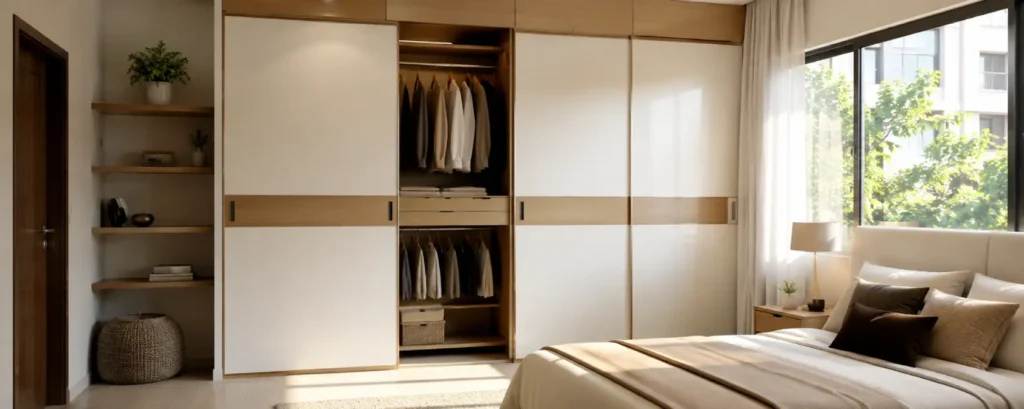
1. Go Floor to Ceiling, Not Just Wall to Wall
Most wardrobes stop well short of the ceiling. That gap on top is dead space. You’re basically paying rent for storage you never use.
Extend your wardrobe all the way up. Use the top for things you don’t need every day, spare blankets, festival clothes, that suitcase you drag out twice a year. Keep the bottom two thirds for daily stuff.
Any carpenter can add this to almost any wardrobe you already have. It’s one of the cheapest wardrobe storage ideas for small bedrooms, since you’re adding storage without adding floor space.
One thing we tell every client though. Don’t make that top section too deep. If you need to drag a stool over each time, you’ll stop using it in a month. Keep it shallow, keep a small stool nearby, and store things in clear boxes so you’re not opening five boxes just to find one scarf.
2. Sliding Doors Instead of Hinged Ones
Hinged doors need room to swing open. In a small bedroom, that swing space is often your only walking space.
Sliding doors fix this right away. They sit flat against the wardrobe and never touch the floor area you actually walk on. We’ve fit full wardrobes into rooms as narrow as 8 feet using sliders, something a hinged door could never have managed.
They look neater too. Fewer hinges, fewer handles, less clutter for the eye in a room that’s already tight. Out of all the wardrobe storage ideas for small bedrooms we recommend, this one usually makes the biggest visual difference.
The only thing is, there’s one little catch. Sliding doors will only allow you to open one side of the door at a time because one panel will always be in front of the other. This may sound a bit slow if you’re a morning picker up who likes to take stuff from both sides. For most, it’s a good price to pay for the additional floor space.
3. Use the Back of the Door
The inside of your wardrobe door is space most people never think about.
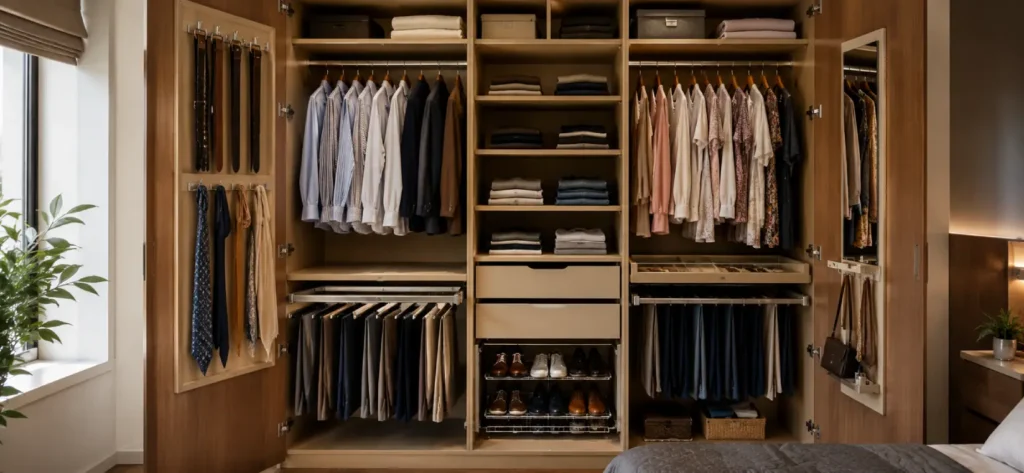
Add a slim hook rail for belts, scarves, or bags. A shallow wire basket works well for socks and innerwear. Even a small mirror with a hidden pocket organiser behind it does two jobs at once.
This is one of those wardrobe storage ideas for small bedrooms that barely costs anything and still adds real use. No carpentry required either. Most of these attach with screws or a strong adhesive hook.
We’ve seen clients fit an entire tie collection, a jewellery organiser, and a shoe pocket rack, all on the back of two doors. Doesn’t sound like much, but over a year, that’s a good amount of clutter that never landed on a shelf or the floor.
4. Build in a Pull Out Trouser and Scarf Rack
If you fold trousers over hangers, you already know how fast that eats up rod space. A pull out rack fixes this completely.
These slide out sideways, hold ten to fifteen trousers or scarves neatly, then slide back in without needing any extra width. These are typically located in the bottom of the wardrobe, just above the bottom section with hangers.
It also helps to prevent creasing of trousers, which nobody is talking about until they start wearing one.
First thing to check is Pull out racks must have more depth than a plain rod, so that they can move smoothly. If you already have a little good wardrobe, have a chat with your carpenter before you install this, to prevent yourself from having a wardrobe that jams every time.
5. Split Your Hanging Space by Height
Most wardrobes give you one long rod running the full height. That’s a waste, because shirts, jackets, and dresses don’t all need the same amount of space.
Split it instead. Use a shorter rod up top for shirts and folded jackets, and free up the bottom half for a second rod, drawers, or a shoe rack. You basically double how much you can hang, in the same width.
This is one of the easiest wardrobe storage ideas for small bedrooms to plan for, since it doesn’t need any extra material, just a smarter layout. This kind of change is easy during the design stage, but harder to add later. Worth getting right the first time. If you’re fixing up an old wardrobe rather than building new, ask your carpenter if the inside frame can handle a second rod without weakening. Most standard frames can, but it’s worth confirming before you start.
6. Add a Loft Above the Wardrobe
Don’t mix this up with idea number one. A loft is a separate box sitting above your wardrobe, usually with its own small shutter.
It’s great for things you barely ever touch. Old files, extra bedding, seasonal decor items. Since it sits high up, it stays out of your eye line and you’re not tripping over boxes on the floor either. This is one of the wardrobe storage ideas for small bedrooms that works well precisely because it doesn’t touch your usable floor space at all.
Keep the loft slightly shallower than the wardrobe below it. Makes the whole thing look lighter and less like a block sitting on top of another block.
Small tip here. Label your loft boxes. We’ve watched clients climb up, open three boxes, and come back down with nothing, more times than we can count. A cheap marker pen saves you that whole routine.
7. Under Bed Storage for the Overflow
Your wardrobe can’t hold everything, and that’s completely fine. Under bed drawers can pick up whatever’s left.
Get a bed frame with drawers built in, or use flat storage boxes if your current bed doesn’t have any. Off season clothes, spare linen, shoes you barely wear, all of this can live under the bed instead of fighting for wardrobe space.
This is one of the most underrated small bedroom storage solutions we know. Mostly because people treat it as an afterthought instead of planning for it from the start.
If you’re buying a new bed anyway, a hydraulic storage bed is worth the extra money. You lift the whole mattress base up, and the space underneath becomes one big storage box. It holds a lot more than separate drawers, though it’s a bit less handy for things you need daily, since you have to clear the bed first.
8. Corner Wardrobes for Awkward Layouts
Small bedrooms usually have one awkward corner nobody knows what to do with. An L shaped or corner wardrobe finally puts that dead corner to work.
You get more storage without pushing the wardrobe further into the room. Corner units are one of the more clever wardrobe storage ideas for small bedrooms with an odd layout, since they use space nobody else bothers with. The only downside is that corner units need a bit more planning inside, since the depth changes across the unit. Talk this through with your designer before finalising the plan.
We designed one recently for a bedroom in Coimbatore, where the client had written off that corner as useless for years. Turning it into a corner wardrobe added close to 15 square feet of usable storage, without the room feeling any tighter. That’s the kind of gain you only get by actually using your corners instead of building around them.
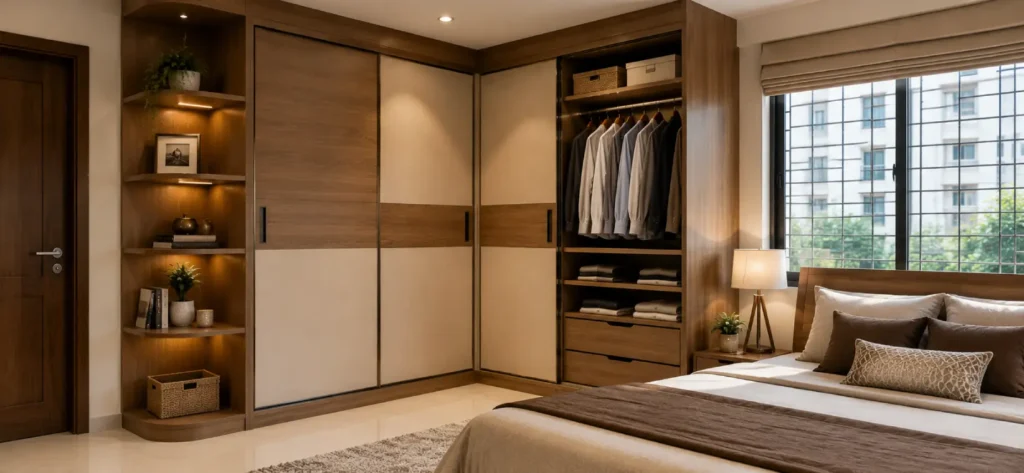
9. Modular Shelves Instead of One Big Cupboard
A single tall cupboard looks neat, but it’s not very smart. Folded sweaters and bulky bags all end up crammed onto the same shelf depth, whether they fit well or not.
You can have each unit of modular shelving programmed to provide its specific needs. There are shallow shelves for folded clothes, deeper shelves for bags and even another compartment just for shoes. Nothing is forced into “one size” that doesn’t fit.
This is where real wardrobe storage tips for little bedrooms really are useful. A generic wardrobe off the rack doesn’t look like the way you organize your wardrobe.
It’s like packing a suitcase. You are not bearding the lion in the den. You use small pockets for chargers, a separate spot for shoes, another for clothes. A well planned wardrobe just does the same thing, permanently, at a bigger scale.
10. Mirror Fronted Shutters to Fake More Space
This one isn’t really about storage. It’s all about the ambience of the room. Even if the wardrobe is able to hold your clothes, a small room can still feel cramped.
Mirrored fronted shutters bounce light around the room and deceptively make the room appear larger. The same storage with a noticeable increase in space. This is a little design trick, but it’s quite effective when we have tested it nearly every time.
One thing to keep in mind. This is suitable for full length mirrors on hinged shutters rather than light sliding mirrors. If you have already bought sliders for additional floor space, consult your carpenter to possibly install just one mirror panel on the front.
A Quick Word on Planning This Right
This is the honest truth about wardrobe storage ideas for small bedrooms. Most of them work best when you plan for them from day one, not add them on after the wardrobe is already built.
We always ask clients a few simple questions before designing anything. How many people use this wardrobe? What’s the mix between hanging clothes and folded ones? Do you need room for accessories, or just clothes? The answers can change the whole layout, sometimes a lot.
A wardrobe that suits one person living alone looks nothing like one shared by a couple. And someone who mostly wears formal shirts needs a different hanging to shelf ratio than someone who lives in kurtas and folded cottons.
Materials Matter More Than People Think
Small bedrooms also deal with heat and humidity differently than bigger, airier rooms. We usually push clients toward moisture resistant boards for the wardrobe body, especially if the room doesn’t get much airflow.
Laminate finishes hold up far better than plain paint over years of daily use. Doors get opened and shut a hundred times a week, and cheap finishes chip fast. It’s a small extra cost upfront that saves you a much bigger repair bill later.
Getting the Depth Right
One mistake we see all the time is wardrobes built too deep for a small room. A standard wardrobe depth sits around 24 inches, but in a genuinely small bedroom, even 4 to 6 inches less can free up enough walking space to change how the whole room feels.
Yes, you lose a little hanging depth. But most clothes don’t actually need the full 24 inches anyway. It’s a trade worth making in tight rooms.
Conclusion
None of these ideas are really effective without the others. A floor to ceiling wardrobe has to have the correct type of door, or it won’t save any space! Planning must be done around a pull out rack. Mirror shutters increase the size of a room, but they provide no additional real storage.
The key is using two or three of these in tandem, and utilizing them according to your lifestyle, not just something you saw in a photo somewhere.
Well, that’s the fun part for us, anyway. Going into a small bedroom, figuring it out how someone dresses in the morning, and structuring a wardrobe around that instead of any one template.
If your small bedroom feels smaller than it is, we’d love to take a look. We’ve addressed the same issue in too many homes across Coimbatore and beyond to make this assumption true in most cases. It’s about how the storage inside it is planned.
Reach out to Terazzo, and let’s build a wardrobe that actually fits how you live, not just how the room looks in a photo.
Frequently Asked Questions
Can I fit all 10 of these ideas into one wardrobe?
No. Choose 2–3 ideas that best suit your space and storage needs instead of trying to include everything.
Should I renovate my old wardrobe or replace it?
If the frame is sturdy, renovation is usually more cost-effective. Replace it only if the structure is damaged or worn out.
How much does a custom wardrobe cost?
The cost depends on the wardrobe size, materials, and design. A site visit helps provide an accurate estimate.
Do I need a designer, or can I hire a carpenter directly?
A carpenter builds the wardrobe, while a designer plans the layout to match your storage needs and maximize space.