
Quartz vs Granite Countertops: Which Is Better for a Modular Kitchen?
Summary
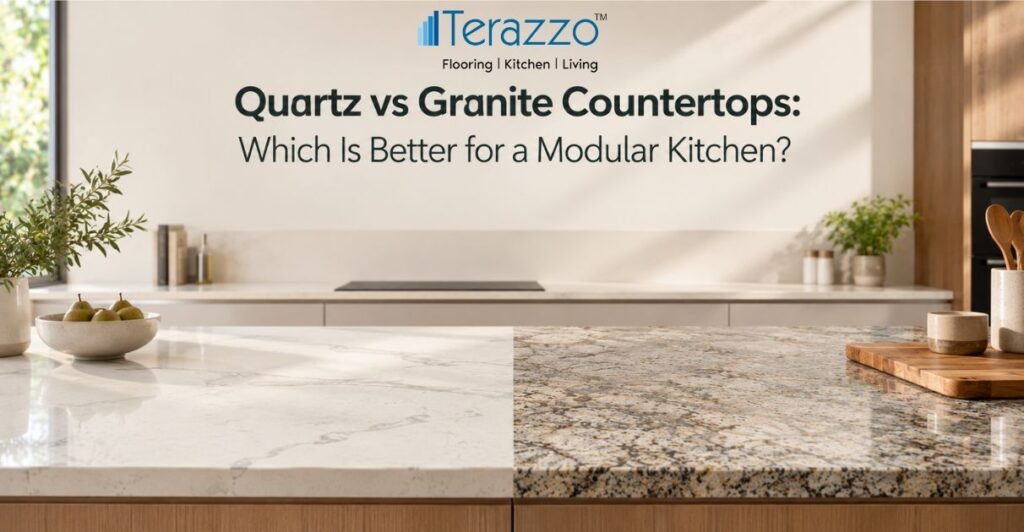
Choosing between quartz and granite for a modular kitchen comes down to a few real factors, not just which one looks more premium in a showroom. Granite is a natural stone, cut and polished with no two slabs looking alike, while quartz is engineered from crushed crystal and resin, giving it a consistent, repeatable pattern.
On durability, quartz holds up better for busy households since it has no pores and resists staining and chipping. Granite is strong too, but needs yearly sealing or it starts absorbing oil and turmeric stains over time. That maintenance gap is the biggest reason many homeowners lean toward quartz for everyday cooking.
Looks are purely personal. Granite offers natural, one-of-a-kind veining, while quartz offers more design control, letting you match a specific color scheme exactly. Heat resistance favors granite slightly, since Indian cooking involves a lot of direct flame-to-counter contact, though quartz still performs well with basic care like using a trivet.
Price isn’t as simple as picking one material over the other. Basic granite can be cheaper than quartz, while premium granite can cost more than high-end quartz. Comparing actual slab grades matters more than assuming one category is universally cheaper.
The blog also covers common mistakes people make, like choosing based on looks alone or comparing prices without checking slab grade, and ends with a practical decision guide based on cooking habits and maintenance willingness. It closes with an invitation to visit Terazzo’s RS Puram studio for a hands-on comparison before deciding.
Share via:
Quartz vs Granite Countertops: Which Is Better for a Modular Kitchen?
Someone walks into our office almost every week holding two stone chips, asking the same thing. Quartz vs Granite, which one should I go with? It’s a fair question. Both materials photograph well. Both get pushed as “the best” by whoever’s trying to sell them to you. And most people genuinely can’t tell the two apart just by looking at a sample the size of a coaster.
We’ve installed both across kitchens all over Coimbatore for years now, so this isn’t coming from a brochure somewhere. It’s what we’ve actually watched happen in people’s homes, sometimes five years down the line, long after the excitement of picking a countertop has worn off and daily cooking has taken over.
If you’re stuck on Quartz vs Granite right now, we get it. Let’s actually go through it properly instead of throwing generic pros and cons at you.
The Basic Difference Nobody Explains Properly
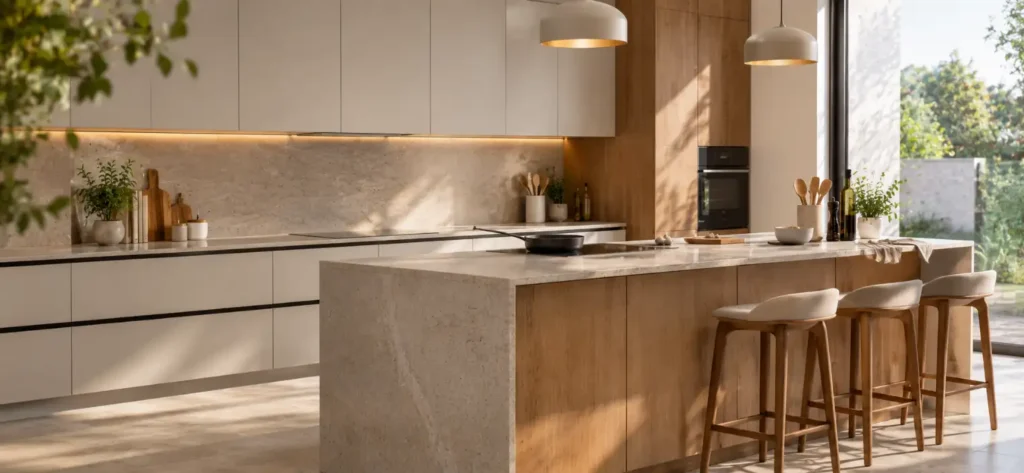
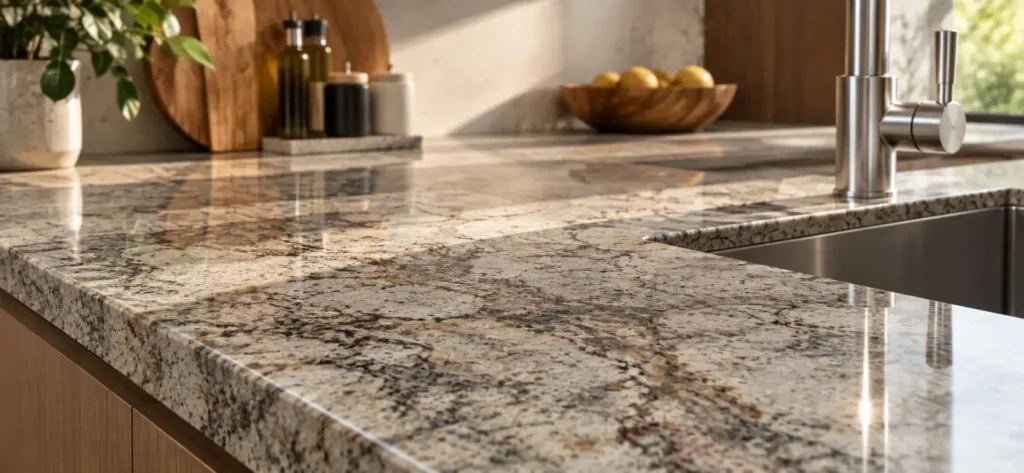
Granite gets cut out of a mountain somewhere, polished, then sealed before it reaches your kitchen. That’s the whole process. Every single slab looks a bit different because nature just doesn’t repeat itself exactly, no two rocks are identical.
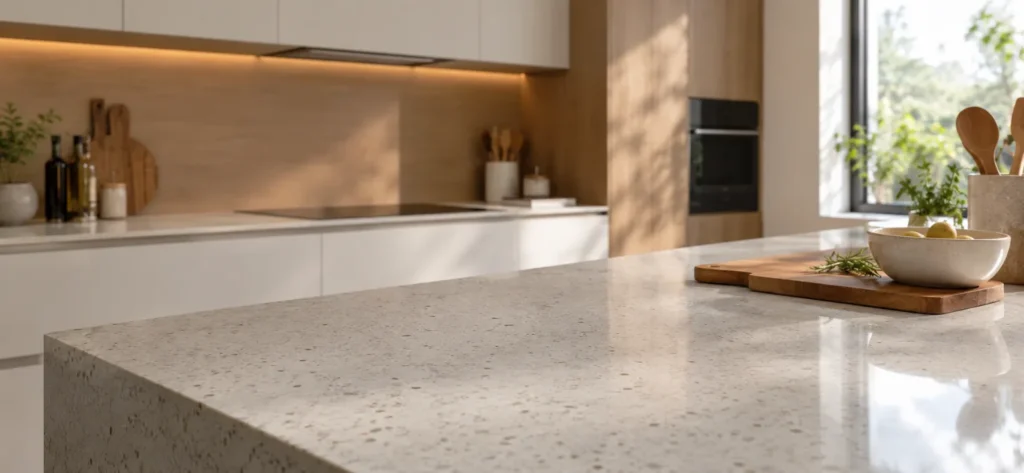
Quartz is made in a factory, start to finish. Crushed quartz crystal gets mixed with resin and pressed into a slab under heat and pressure. Order the same design twice, months apart, and it’ll still look the same. That consistency is honestly the biggest reason a lot of our clients lean toward it.
Once you understand that one thing, natural stone versus a manmade slab, most of the Quartz vs Granite conversation starts making a lot more sense. Everything else, the durability, the price, the way it ages, all traces back to this.
Which One Actually Survives Daily Cooking?
Granite handles scratches better than most people expect. You can even rest a hot pan on it for a short while and nothing dramatic happens. But it has tiny pores running through it, invisible to the eye. Leave a turmeric stain sitting too long, or skip sealing it for a year, and it soaks that stain right in. We’ve seen granite counters in real homes with a permanent yellow ring where someone left a dal pot overnight, just once.
Quartz avoids that entirely. No pores means most stains sit on the surface and wipe off instead of sinking in. It resists chipping better too, especially near the sink edge where heavy vessels tend to bang around. For a kitchen running three meals a day, every single day, we’d lean toward quartz nine times out of ten when this exact question comes up.
That said, granite isn’t fragile. People sometimes assume natural stone is delicate, and it really isn’t. It just needs a bit more attention than quartz does.
Maintenance: Be Honest About What You'll Actually Do
This is the part people gloss over when picking finishes, and then regret later, usually around the two year mark.
Granite needs sealing. Once a year at minimum, twice a year if the kitchen sees heavy use. Skip it, and the stone slowly starts absorbing oil, spice stains, and whatever else touches it, often without you noticing until the damage is already done.
Quartz just needs a wipe down. That’s genuinely the extent of it. No yearly ritual to remember, no calling someone in to reseal it.
So when clients ask us directly which one is less work, we tell them the truth without dressing it up. Quartz is lower maintenance, full stop. Granite works fine too, but only if you’ll actually commit to sealing it every year like clockwork. Be honest with yourself about whether that’s realistic for your household before choosing based on looks alone.
Looks: This One Really Is Just Taste
We won’t pretend one wins here, because it genuinely comes down to personal preference.
Granite has that natural, slightly wild movement running through it. Swirls, dark flecks, veining that no machine could plan or replicate. If you want a countertop that looks like nobody else’s on the street, granite gives you that automatically, just by being natural stone.
Quartz is more controlled and predictable. You can match a specific shade to your cabinets, get a clean marble-style finish without the marble maintenance headache, or go bold with a color that doesn’t even exist in real stone. A lot of our modern kitchen clients pick quartz specifically because it lets them match their cabinet tone exactly, down to the shade.
If your kitchen leans sleek and minimal, quartz tends to sit better visually. If it’s warmer and more textured, granite fits that mood more naturally. Neither is the wrong call. It genuinely depends on the story your kitchen is telling.
What About Heat? Because Indian Cooking Runs Hot
This part matters more here than in a lot of other countries, because Indian cooking involves constant direct heat. Tempering, deep frying, moving hot kadhais and tawas around the kitchen without much thought.
Granite takes heat well since it’s real stone straight from the ground. A hot pan set down for a few seconds won’t hurt it, and most people don’t think twice before doing it.
Quartz is a bit more sensitive because of the resin content inside it. Direct heat for too long, or repeated exposure in the same spot, can cause discoloration over time. Even brands that market their quartz as heat resistant still tell you, in the fine print, to use a trivet. We tell our clients the exact same thing, use a trivet regardless of what the packaging claims, just to be safe.
If your everyday cooking involves pans going straight from flame to counter constantly, this genuinely deserves real thought, not just a passing mention, when you’re weighing Quartz vs Granite.
Price: It's Not As Simple As People Assume
Everyone walks in assuming one material is flatly cheaper than the other. It really isn’t that straightforward once you look closely.
Basic granite can actually cost less than mid-range quartz. But premium imported granite? That can easily cost more than high-end quartz, sometimes by a wide margin.
Quartz pricing tends to be a bit more predictable since it’s factory made rather than dug up and graded like granite is. Mid-range quartz options usually land close to mid-range granite pricing. Designer quartz ranges, though, get expensive fast, sometimes surprisingly so.
Our honest advice, the same thing we tell every single client who asks, is to compare the actual slabs you’re considering side by side. Don’t assume the whole material category is cheaper or pricier just based on general reputation. Grade matters far more than the label of quartz or granite on its own.
Water, Moisture, and the Stuff Nobody Mentions
Indian kitchens deal with a lot of water. Washing vessels, rinsing vegetables, the occasional overflow from the sink area. This part of the Quartz vs Granite conversation rarely comes up, but it should.
Granite handles water fine once it’s properly sealed, since the sealant blocks moisture from getting into those tiny pores we mentioned earlier. Unsealed or poorly sealed granite, though, can develop water rings or dull patches near the sink over time.
Quartz doesn’t have this issue at all, because there are no pores for water to get into in the first place. Around the sink cutout specifically, quartz tends to hold up cleaner over the years with noticeably less fuss.
Mistakes We See People Make Choosing Between the Two
A few patterns keep repeating across different homes and different clients, so it’s worth mentioning them directly.
- Picking granite purely because it seems more “premium” without checking if the household will actually maintain it
- Picking quartz without checking whether their cooking style involves a lot of direct heat exposure
- Comparing prices across entire material categories instead of comparing the actual grade of slab in front of them
- Choosing based on a tiny sample chip that looks completely different once it’s laid across an entire counter
- Not asking how the edges will be finished, which affects both durability and final look more than people expect
We bring these up early with every client now, because they’re avoidable headaches if someone just asks the right questions before signing off on a slab.
Quick Gut Check
If you’re still torn between Quartz vs Granite after all this, here’s roughly how we’d guide you based on what actually holds up in real homes we’ve worked on.
- Cooking heavy, every single day, big family: quartz saves real effort long term
- Lots of direct flame to counter cooking, tawas and kadhais moved around often: granite handles that better
- Want something no one else on your street has: granite’s natural variation wins here easily
- Need to match a very specific kitchen color scheme: quartz gives you far more control
- Want to basically never think about the counter again: quartz, without question
- Like the idea of real natural stone and don’t mind sealing it once a year: granite still holds up beautifully
Where We Actually Land on This
There isn’t one universally right answer here, and we’ll be upfront, anyone insisting there is one is probably just trying to close a sale quickly. Quartz vs Granite comes down to how you cook, how much upkeep you’re genuinely willing to commit to, and the look you want walking into your kitchen every single morning for years to come.
Want low effort and predictability above everything else? Quartz is the safer long-term bet for most households. Love the character of natural stone and don’t mind the yearly sealing routine? Granite still holds up beautifully and ages with real personality.
What matters more than the material choice itself, honestly, is how well the countertop gets planned around your actual kitchen layout and your actual daily habits. That part gets overlooked far too often, and it’s usually what makes the biggest difference five years in, not the material label on the invoice.
Come Talk to Us Before You Decide Anything
We’re not going to hand you a catalog and leave you to figure out Quartz vs Granite on your own through guesswork. At Terazzo, we sit down with you, ask how you actually cook, how your household actually uses the kitchen day to day, and help you choose between quartz and granite based on that reality, not just what photographs well for social media.
If you’re planning a modular kitchen anywhere in Coimbatore and you’re genuinely stuck between the two, drop by our RS Puram studio. We’ll put real slab samples in your hands, walk you through the trade-offs honestly without the sales pitch, and help you land on a countertop you won’t be second-guessing two years from now.
Frequently Asked Questions About quartz or granite
1. Is quartz or granite better for a kitchen?
Both are good choices, but quartz is easier to maintain while granite offers a more natural look.
2. Is Taj Mahal quartz or quartzite?
Taj Mahal is a natural quartzite, not engineered quartz.
3. Which is better for an Indian kitchen, granite or quartz?
Granite is often a practical choice for Indian kitchens because it handles heat well and is generally more forgiving.
4. Which is costly, granite or quartz?
Quartz is usually more expensive than standard granite, though the price varies by quality and design.
5. What are the negatives of quartz countertops?
Quartz can be sensitive to high heat and may cost more than many granite options.