
How to Choose Curtains for Small Rooms
Summary
Choosing the right curtains for small rooms is one of the easiest ways to make a compact space feel brighter, more open, and visually larger. This blog explains how simple design choices such as selecting light-coloured curtains, matching them with your wall colour, and installing curtain rods closer to the ceiling can create the illusion of higher ceilings and wider windows. These practical tips help maximize natural light and improve the overall appearance of bedrooms, living rooms, home offices, and other small spaces without requiring expensive renovations.
The guide also explores how fabric, length, and pattern influence the way a room feels. Lightweight materials like linen, cotton voile, and linen blends allow more light to filter through while maintaining privacy, making the room feel airy and welcoming. It also recommends using floor-length curtains to create a seamless vertical line and choosing subtle patterns or soft textures that add character without overwhelming the space. Along with these suggestions, the blog discusses how room orientation, lighting conditions, and proper curtain width can impact the final look.
Finally, the blog highlights several common mistakes homeowners make when choosing curtains for small rooms, including selecting dark colours, hanging curtain rods too low, using heavy fabrics, and ordering the wrong size. It provides practical buying advice, measurement tips, and answers to frequently asked questions to help readers make confident purchasing decisions. Whether you’re decorating a new home or refreshing an existing room, these expert recommendations can help you choose curtains that enhance comfort, style, and functionality while making even the smallest room feel more spacious.
Share via:
How to Choose Curtains for Small Rooms
We hung curtains in our first apartment and forgot about them for two years. Grabbed whatever was on the shelf, stuck the rod above the window, and moved on with life. Then one evening we walked in and just felt it. The room looked like a cave. Dark, heavy, weirdly tight, even though the space itself was not that small.
It took us way too long to admit the curtains were the problem.
Turns out picking the right curtains for small rooms is its own little skill. That’s not something anyone tells you unless you’ve been living in a room for two years which is smaller than it looks. After we realized what were our mistakes, the solution was quite straightforward. There are a few things that most people mess up, but once you avoid these, the whole room can change without moving anything else.. We are sharing what we learned so you can skip the cave phase entirely.
Start With Colour
Dark curtains soak up light instead of bouncing it back. That is the whole problem with them. They sit there pulling in brightness and holding onto it, so the room feels dim even when the sun is out.
Lighter shades do the opposite. Think soft cream, pale grey, warm sand. They throw light back into the room. The space does not actually grow, but the right curtains for small rooms can certainly make it feel bigger.
This is a tip that very few people follow match your curtain colour with your wall colour. It doesn’t have to be a 100% match; it can be a similar family. If the two combine, your eye will roll over the wall rather than stopping at the window. The room appears to be in a single space. Just grab a curtain that is a completely different color and suddenly that’s where your eye goes and the window is a frame in the middle of the wall.
Best, this does not cost you an additional penny. You are just choosing a shade close to your existing paint.
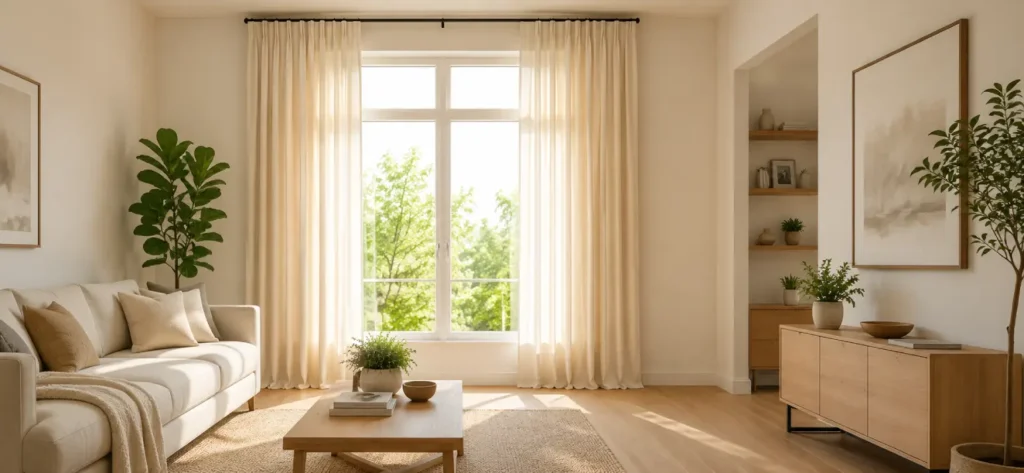
Sage green, dusty blue, warm ivory, these all work nicely as curtains for small rooms if you want a little personality without going dark. Stay away from anything too saturated or too deep. Those shades need a bigger room to soak them up properly.
Something to consider: the direction of your room. A north facing room with minimal amount of sunlight is better with warmer, lighter shades as cool greys tend to look cool and a bit grey in the absence of adequate sunlight. Rooms that are south facing and are well lighted will allow you more flexibility a dusty blue colour will not feel cold. When choosing curtains for small rooms, it’s a minor factor but it will be apparent the second you make the wrong choice.
Nobody Gets the Rod Position Right
Most people hang the rod right above the window frame. Sounds reasonable. However, it’s actually what makes a small room appear shorter and boxier than it truly is.
Place the rod closer to the ceiling, 4-6 inches down. Extend 10-12 inches beyond the window frame on either side. Always, always touch the ground with the panels.
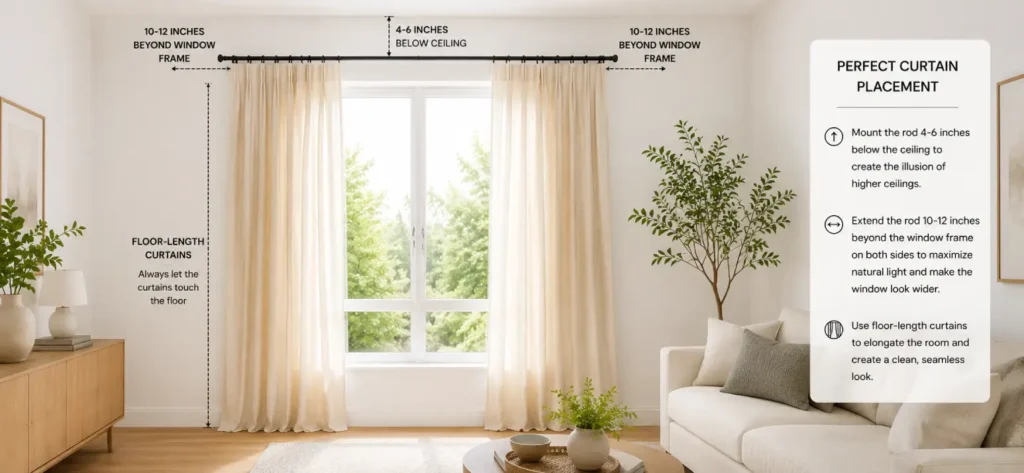
This is how this works. The curtain will be hung up from the top of the wall so that your eye must reach upward to locate the curtain’s top. This helps to make your brain think the ceiling is higher. The wider width of the rod also allows more light to enter and allows you to see through the window, as the curtain does not cover the window.
This is the most impactful change when choosing curtains for small rooms. We have seen it do wonders in rooms where nothing else proved to work.
The length of floor is as important. Window-length curtains or curtains hanging in the middle of the wall give the room an unfinished look. They break the line your eye wants to follow from ceiling to floor. Let them touch the ground and the room suddenly looks pulled together.
Fabric Gets Ignored, and It Shouldn't
People obsess over colour and barely think about fabric. That is backwards.
Heavy fabric works against you in a small room. Thick velvet, dense wool, stiff blackout panels, they all carry visual weight that makes a space feel closed in. In a big room, that weight reads as cozy. In a small room, it just feels like the walls are creeping inward.
Lighter fabrics are one of the best choices for curtains for small rooms because they let a room breathe. It moves a little when someone walks by. It softens the light instead of blocking it. The room feels alive instead of stiff.
Linen is what we reach for with small room curtains nearly every time. It has a natural, slightly rumpled texture, it is not see through so you keep your privacy, and it lets warm light filter in just right. Cotton voile works well too, especially in sunnier rooms, since it is light and breezy. Sheer polyester is a fine pick if you are on a budget. And a linen cotton blend gives you a bit more structure if pure linen feels too floppy.
Need to block light at night? Do not reach straight for heavy blackout fabric. Try layering instead. Hang a light sheer underneath and a thicker panel on top. During the day, pull the thick layer back and let the sheer handle things. At night, close both. You get full darkness without your room turning into a sealed box.
Before buying anything, run your hand across the fabric in the shop. If it feels stiff and heavy in your hands, it will feel even heavier once it is up on your wall. Good curtains for small rooms should feel light the second you touch them.
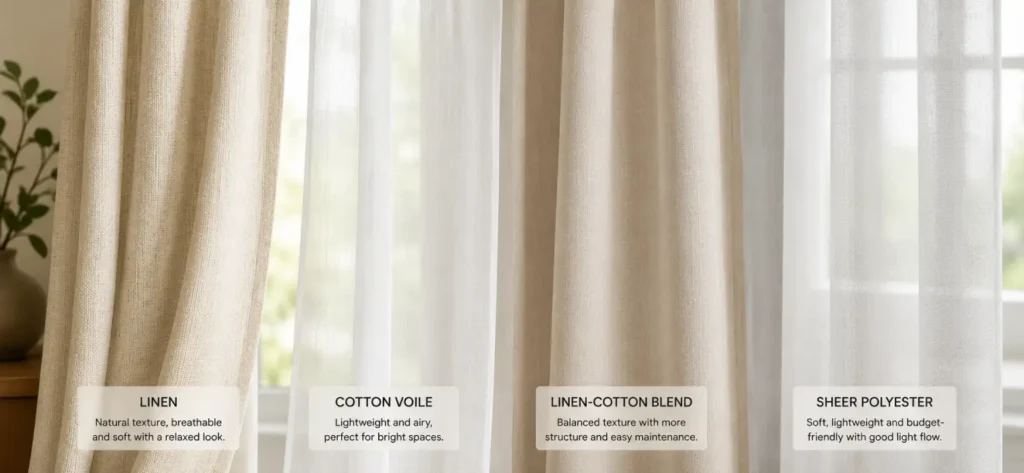
One more thing on upkeep. Linen wrinkles easily, and most people actually like that relaxed look, but if a crisp finish matters to you, go with a linen cotton blend instead. Cotton voile washes and dries fast, which is handy if you’ve got a kitchen window nearby catching steam or grease. None of this changes how the room looks day to day, but it does decide how much work you’re signing up for, so it’s worth knowing before you order three panels of anything.
On Patterns
You do not have to go plain. Patterns can work in small spaces, just not all of them.
Thin vertical stripes are probably your safest bet. They pull the eye upward, adding a sense of height. Keep the colours close in tone rather than going high contrast. A white curtain with soft grey stripes is a good example, clean and simple, and it suits almost any room.
Small prints work too. A tiny floral, a small geometric shape, a subtle texture. If you can make out the pattern clearly from across the room, it is probably too big for the space.
Wide horizontal stripes are the ones to avoid. They flatten a room fast. Same goes for bold, high contrast colours, since they tend to take over a small space in a way that feels more overwhelming than interesting.
Stuck on what to choose? Plain is always the safe option for curtains for small rooms. Bring in pattern through a cushion or rug instead. Much easier to swap out later, and you don’t have to redo your windows.
Practical Stuff Before You Order
Measure from where the rod will actually sit, not from the window frame itself. That means measuring from ceiling to floor. Standard panels come in 84 or 96 inches, but if you’ve got high ceilings, you willl probably need 108-inch panels or something custom.
Order a fabric swatch before you commit to anything. Colours read differently at home compared to online or in a shop. Something that looks warm ivory on your screen can turn slightly yellow once it is under your lamp at night. A swatch only takes a few days to arrive, and it saves you from an expensive mistake.
On width, most people underestimate how much fabric they actually need. A panel that barely reaches the rod looks thin and flat. For a fuller, more gathered look, your total curtain width should be roughly one and a half to two times the length of the rod.
It is also worth checking the header style:
- Rod pocket and back tab headers: simple, minimal, and easy to hang
- Grommet tops: slide open smoothly, great for casual rooms
- Pinch pleat headers: a more formal look, pairs nicely with linen
Mistakes We Made So You Don't Have To
We’ve made just about every mistake possible when it comes to curtains for small rooms, so this is the short list of what to skip:
- Buying based on a photo alone. Photos almost always lighten fabric. Order a swatch first.
- Going dark because it looked cozy online. Cozy in a photo often turns into dim and tight in real life.
- Hanging the rod at window-frame height. We did this for two whole years. Learn from us.
- Picking a heavy fabric because it felt premium in the shop. That same weight can feel suffocating once it’s hanging across a whole wall.
- Skipping the floor-length rule for “just one window.” It’s never just one window. You’ll notice.
None of these mistakes cost much to fix, which is the annoying part, honestly. We could have sorted our whole living room in one afternoon if we’d known any of this earlier.
Conclusion
Choosing the right curtains for small rooms starts with mounting the rod near the ceiling. Let it run wider than the window. Choose something light in colour and weight. Take the panels all the way to the floor.
Those four changes are what actually shift how a room feels. We have watched them work in cramped apartments, narrow bedrooms, and tight living rooms, every single time. And getting the right curtains for small rooms almost never costs as much as people expect going in.
If you would like a hand figuring out what suits your windows, take a look at our collection. We built it with small room curtains in mind, and we’d genuinely love to help you pick the fabric, colour, and length that fits your space. Come have a look, and let’s get your windows looking the way they should.
Frequently Asked Questions
Do curtains have to match the walls exactly?
No, close enough does the job. When curtains for small rooms sit near the wall colour, your eye moves past the window instead of getting stuck on it. That’s what makes a room feel bigger.
Can you use blackout curtains?
Yes, just keep them light in colour. A cream or white blackout panel works at night without weighing the room down during the day. Dark blackout fabric in a small room tends to swallow the whole space.
How long should they be?
Floor length, every time. Panels that stop above the floor make the ceiling feel lower and look unfinished. Floor-length small room curtains add height and tie the whole room together.
Are patterns off limits?
Not at all. Thin stripes and small prints both work fine. Just steer clear of bold, high-contrast patterns, since they tend to take over a smaller space. If you’re unsure, plain is always the safer bet.