
Modular Kitchen Colour Combinations for Indian Homes
Summary
Choosing the right modular kitchen colour combination depends on your kitchen’s size, natural light, cooking habits and overall home design. Light shades like white, beige and grey make compact kitchens feel spacious, while darker colours such as navy, olive and black can help conceal everyday stains. Popular combinations include white and wood, sage green and beige, navy blue and white, terracotta and cream, and teal with light oak.
Two-tone cabinets are a practical choice, with darker shades below and lighter shades above. Pair them with suitable countertops, such as quartz or granite, and choose matte or glossy finishes based on your needs. Lighting also matters. Warm white lights complement earthy tones, while cooler lighting works well with blues, whites and greys.
Avoid using too many bold colours, and always check larger samples under your home’s lighting before deciding. At Terrazzo India, you can get expert guidance to choose colours, finishes and countertops that suit your space and lifestyle.
Share via:
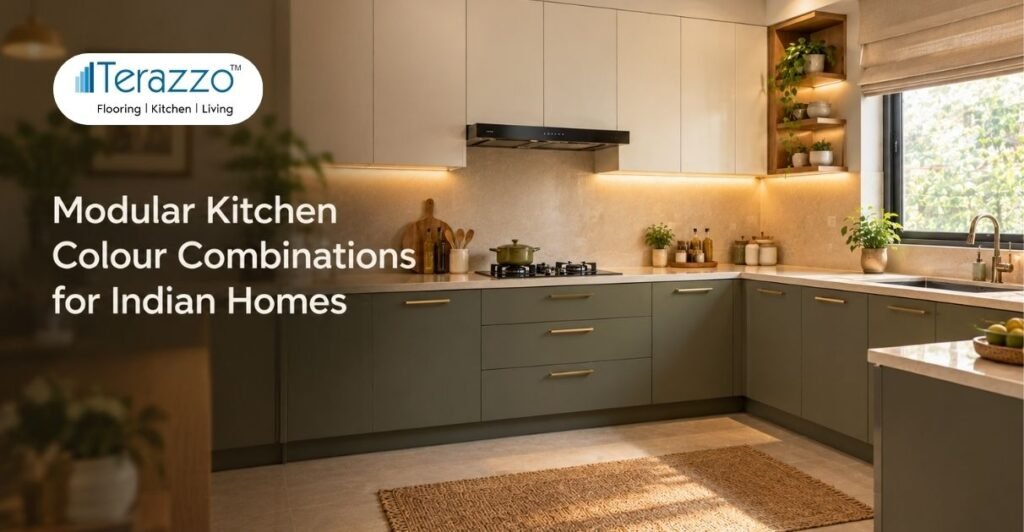
Modular Kitchen Colour Combinations for Indian Homes
Most people think choosing a modular kitchen colour combination will take ten minutes. Then they visit a showroom. Twenty laminate samples later, nothing looks right anymore, and the salesperson keeps saying “this one is trending, sir.” We see that tired look on people’s faces almost every week at our studio.
This is the thing. Your kitchen works harder than any other room in the house. Tadka smoke, haldi, the cooker blowing steam at the ceiling, oil from yesterday’s bajji. A colour has to look good through all of that, not just on the brochure.
So we put this guide together from what we have actually seen work in Indian homes. Some of it is about colour. Some of it is about the boring stuff like finishes and bulbs, which turns out to matter a lot.
Why colour matters so much in an Indian kitchen
Colour changes how big the room feels. It changes how bright the kitchen looks when you’re making dinner at 8 pm. And yes, it changes how often you scrub the cabinet doors.
Light shades open up a small kitchen. Dark shades hide stains but can close a room in. Gloss shows every fingerprint, matte forgives a lot. If you keep just those three points in your head, you’ll already make better choices than most.
A good modular kitchen colour combination should still look decent after three Diwalis of murukku and bajji. That’s our test, anyway.
Before you pick anything, look at your own kitchen
Stand in your kitchen for five minutes and notice a few things.
How much sunlight comes in? A big window means you can play with navy or bottle green. One small window, or none, and you should stay light. We’ve seen dark kitchens without windows, and they feel like a store room by evening.
How big is it? In most city flats the kitchen is compact. We usually keep the top cabinets light and go a shade or two darker at the bottom. The room stays open, and the lower doors don’t show every kick and scratch.
How much do you cook? If your house runs on three fresh meals a day, pick finishes that don’t mind grease. Glossy white is lovely. You will also wipe it every single night.
Is the kitchen open to the hall? Then your modular kitchen colour combination has to sit well with the sofa, the floor and the walls. Otherwise it looks like two houses joined together.
One more thing people skip. Think about who uses the kitchen. If your amma spends four hours in there every day, ask her what she likes. She is the one who will look at those cabinets the most. And if you have small kids who love touching everything, a darker or mid tone shade on the lower doors will save you a lot of wiping. A modular kitchen colour combination that fits your family’s routine will always beat one that only looks good in photos.
10 colour combinations we keep coming back to
Some of these our clients ask for all the time. A couple are less common, and we wish more people tried them.
1. White and warm wood
The safe one, and there’s no shame in safe. White up top keeps things bright, and wood (or a wood finish laminate) below adds warmth. Wood also hides daily marks, and this pair goes with almost any countertop.
If you want a modular kitchen colour combination you won’t get bored of in five years, start here.
2. Grey and white
Clean, calm and very practical. Light grey hides dust better than plain white but still keeps the room light. A grey base, white upper section, and stainless steel handles create a clean, simple look.
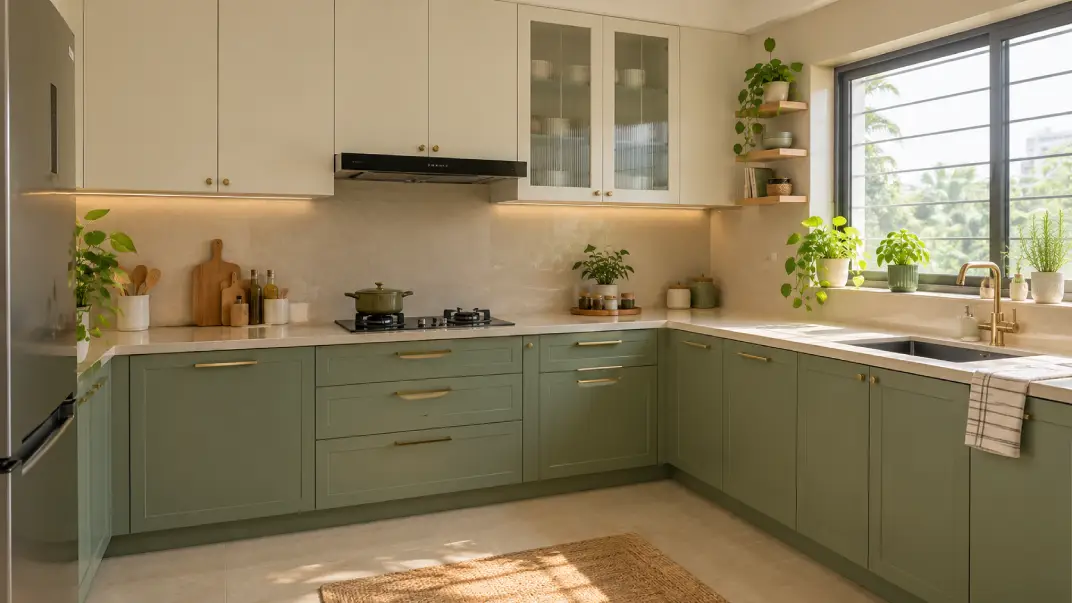
3. Sage green and beige
Sage is probably the easiest green to live with. It’s soft and earthy, and with beige or off white it looks really nice in homes that get a lot of sun and have a few plants around. It doesn’t shout. We like that about it.
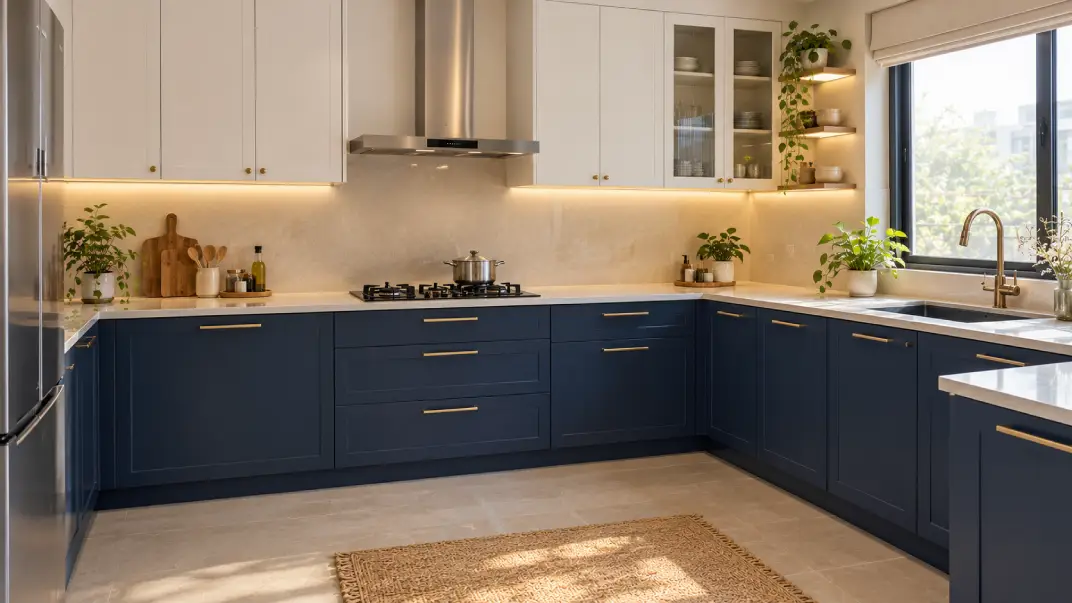
4. Navy blue and white
Bold but still classy. Navy at the bottom, white on top, maybe brass handles if you like a little shine.
Just one warning. Navy needs light. In a dim kitchen it feels heavy fast. If you love it anyway (we understand, it’s a gorgeous colour), go for a light countertop and put strip lights under the top cabinets.
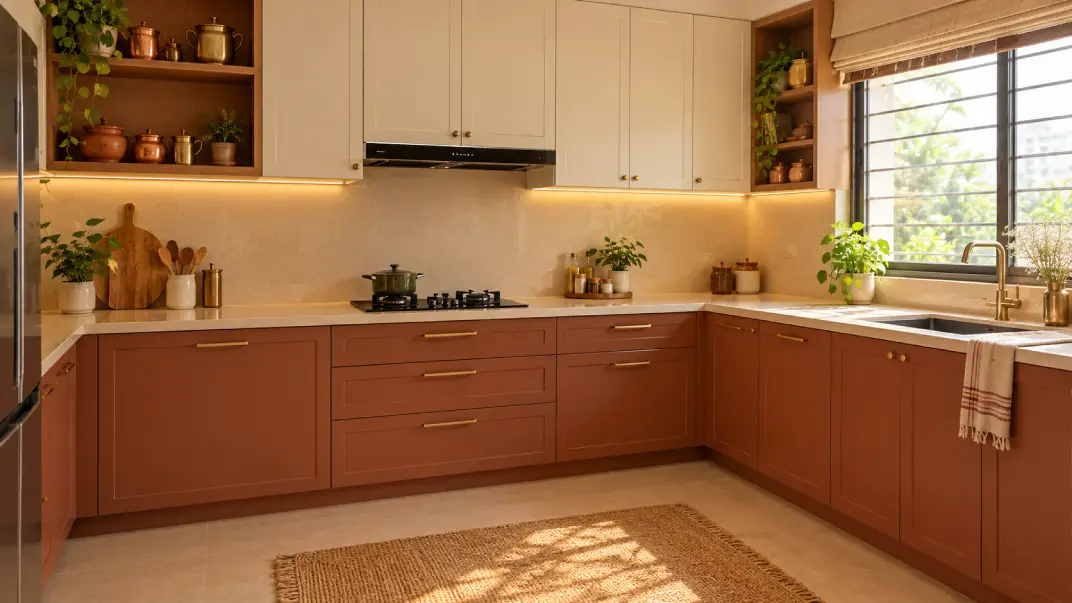
5. Terracotta and cream
This modular kitchen colour combination feels very Indian to us. Terracotta brings back clay pots and old homes with a thinnai out front. Cream keeps it from getting too dark. Throw in an open wooden shelf for your copper and brass vessels and the whole kitchen feels like home.
6. Mustard yellow and grey
Mustard is yellow that has grown up a bit. Use it on a few cabinets or on the island, and keep the rest grey. You get some personality, and your kitchen doesn’t end up looking like a play school.
7. Black and wood
Matte black with wooden touches looks modern and a little dramatic. It hides stains really well too, which heavy cooking families will appreciate.
But we only suggest it for bigger kitchens with good lights. In a small kitchen, keep black for the bottom cabinets and go light on top.
8. Blush pink and white
Not for everyone. That’s fine. If you like soft, pretty rooms, blush with white and rose gold handles looks sweet. Please go matte though. Glossy pink starts to look like plastic.
9. Olive green and off white
Olive is deeper than sage and a lot more forgiving. Haldi stains don’t jump out on it the way they do on pale colours. With off white, it gives the kitchen a relaxed, almost village house feel.
10. Teal and light oak
If you desire colour but you don’t want to be crazy. The teal makes it lively, the oak makes it more calm. This modular kitchen colour combination is particularly great for open kitchens, where the teal can be accented with a cushion or a rug in the living room.
The two tone trick
You might have noticed that nearly every pair above uses two colours. That’s on purpose.
Bottom cabinets take a beating. Feet, mop water, kids, the gas cylinder trolley, the dog. In the main, top cabinets are free from problems. Therefore the darker shade below and a lighter shade above maintains the kitchen’s freshness for a longer period of time. At the very least, add an accent, such as handles or a tile, to complete the look, and you’re done.
Truthfully, if you can’t pick a modular kitchen colour combination, choose a two tone colour scheme. It’s very hard to get wrong.
Don't forget the countertop and backsplash
People spend weeks on cabinet colours and five minutes on the countertop. That’s backwards, because the top and the tiles behind it take up a big part of what you see.
Stylish granite options for white cabinets include black and grey.Black or grey granite are great options for white cabinets. Wooden cabinets go nicely with a white or cream quartz top. In the case of cabinets that are bold, navy or teal, allow the countertop to be plain and light. But when the cabinets you have are simple, it’s time to get creative with patterned tiles.
Granite or quartz is the most recommended for Indian cuisine. Easy to handle both heat and stains. Granite is a NATURAL stone. Factories blend crushed stone to quartz and it absorbs less stains and is easy to clean.
Matte or glossy?
The same colour can appear in two different shades when paired with the different finishes, therefore select modular kitchen colour combination and finish at the same time.
Matte is soft and won’t mark as it will not leave marks. This is suitable for dark colors. While gloss reflects light around it, and helps make a small kitchen appear larger, it also accentuates blemishes. Then there’s the material:
- Laminate is a printed sheet pasted on the cabinet board. Affordable, lots of colours, easy to clean.
- Acrylic is a very shiny, almost mirror like sheet. Looks rich, needs frequent wiping.
- PU paint is a smooth painted coat. Almost any shade is possible, but it costs more.
What do we usually tell people? Matte laminate below, gloss or acrylic above. For most homes that mix just works.
Lighting can make or break your colours
This is surprising. You can have the beautifully designed perfect modular kitchen colour combinations and still not be happy when the lights are switched on. Yellow bulbs and white tube lights are very different at transmitting colour.
Wood and earthy colours are best with warm white bulbs (approx. 3000K). Cool white (about 4000K) is good for greys, whites and blues. The “K” is a Kelvin, which simply indicates the colour of the light, yellow or white. Numbers lower are more yellow.
Two more things. Place strips of LED light underneath the upper cabinets so that the counter will always be lit. And sample at home at night not under showroom lights!
Mistakes we see far too often
We’ve walked into many kitchens that looked amazing in the 3D render and a bit sad six months later. A few reasons keep showing up.
The first is going all white in a house that cooks a lot. Every oil drop shows. Every haldi splash shows. If you love white, choose off white, or add a darker bottom cabinet.
Then there’s using too many colours. Three or four bold shades in one small room just looks messy. Two main colours and one accent is plenty.
People also forget the floor. A lovely modular kitchen colour combination can look odd next to the wrong tiles, so carry a photo of your flooring when you go to choose.
Tiny samples are another trap. A 2 inch square looks nothing like a full wall of cabinets. Ask for a bigger sample, or photos of finished kitchens in that shade.
And finally, trends. They change every year. Pick a colour you’ll be happy to see every morning, not the one going viral this month.
What about Vastu?
Plenty of families like to follow Vastu when planning a kitchen, and we respect that. Generally, warm colour is preferred in the kitchen in Vastu, such as yellow, orange, red, and earthy browns and in some cases light green, is preferred.
The good news is that terracotta and cream (or mustard and grey) fit in nicely. So you can keep the elders at home happy and still get a kitchen you actually like.
Conclusion
Colour is personal. Your neighbour’s kitchen might look great, but it was planned for their light, their space and the way they cook, not yours.
That’s where we come in. At Terrazzo India, we design modular kitchens around how you really live. We’ll help you test samples in your own space, match cabinets with the right countertop and lights, and stay with you until you land on a modular kitchen colour combination you’ll still love years from now.
Give us a call or drop by Terrazzo India to book a free design consultation. Bring your saved photos, a rough idea, or nothing at all. We’ll figure it out with you.
Frequently Asked Questions About modular kitchen colour combination
1.Which modular kitchen colour combination is best for a small kitchen?
Stick to light colours. White and wood, grey and white, or sage and beige all keep a small kitchen feeling open. A glossy finish on the top cabinets helps spread the light.
2. What are the best colors to conceal stains?
Darker and medium colors such as olive, grey, navy, black and wood. Matte hides has a better performance than gloss.
3. Is a dark kitchen a good idea in India?
It can be, if you get decent light and have enough space. If the kitchen is darker or smaller, only dark coloured bottom cabinets.
4. I want a modular kitchen in the combination of colours in an open kitchen, how do I choose it?
Check out your living room and dining room first. Select cabinet colors that coordinate with your sofa, curtains and floor, to make the entire space seem one room.
5. Do kitchen colours affect resale value?
A little. Kitchens that are neutral or two toned are more appealing to more buyers. A color scheme that’s appropriate for a few years down the road is a classic, white and wood or grey and white modular kitchen color scheme.