
Best Wardrobe Material for Indian Homes
Summary
Choosing the right wardrobe material depends on budget, climate, and how the wardrobe gets used not just looks. The blog breaks down five main options.
Plywood, made from glued wooden layers, handles moisture well and holds hardware securely. It comes in grades (MR, BWR, BWP), with BWP being ideal for bathrooms or coastal areas, and MR suiting regular bedrooms. It costs more but lasts 15-20 years.
MDF (Medium Density Fibreboard) gives a smooth finish, great for curved or painted shutters, and costs less than plywood. However, it absorbs water quickly and doesn’t hold screws as well over time, making it unsuitable for damp areas.
Particle board is the cheapest option, common in rentals, but weakest against moisture and heavy daily use.
WPC (Wood Plastic Composite) is genuinely waterproof and termite-proof, ideal for wet areas like bathrooms, though pricier and requires an experienced carpenter.
Solid wood (teak, sheesham) is durable but expensive, needs maintenance, and has largely been replaced by plywood/MDF for practical budgets.
The blog clarifies that laminate and veneer are finishes, not base materials they sit on top of plywood, MDF, or particle board. It also notes that door type (sliding vs. hinged) and hardware quality (hinges, channels) matter as much as the base material itself.
Common mistakes include prioritizing price or looks over moisture-resistance and hardware quality, and not checking plywood grades. The piece closes with Terazzo’s approach: recommending MR-grade plywood by default, BWP where moisture is a concern, and WPC for fully wet areas tailored honestly to each client’s needs.
Share via:
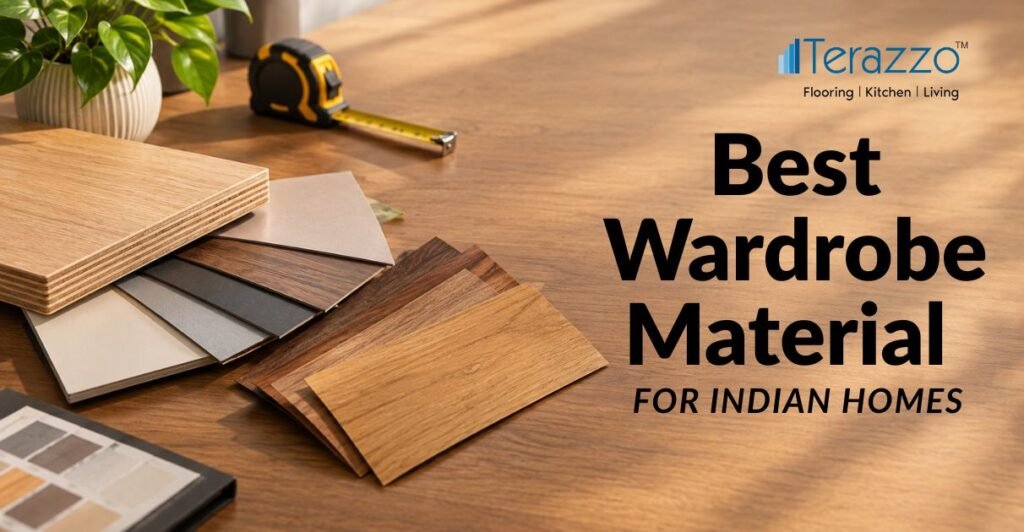
Best Wardrobe Material for Indian Homes
Every second client asks us this at Terazzo. “Which wardrobe material should I use?” There’s no simple yes or no answer here.
It depends on your budget. Your city. How much your kids slam doors. Even your husband, who opens the wardrobe twenty times looking for one shirt.
So instead of giving you a generic answer, let’s go option by option. What each wardrobe material actually is, what it costs, and where it lets you down after a few years.
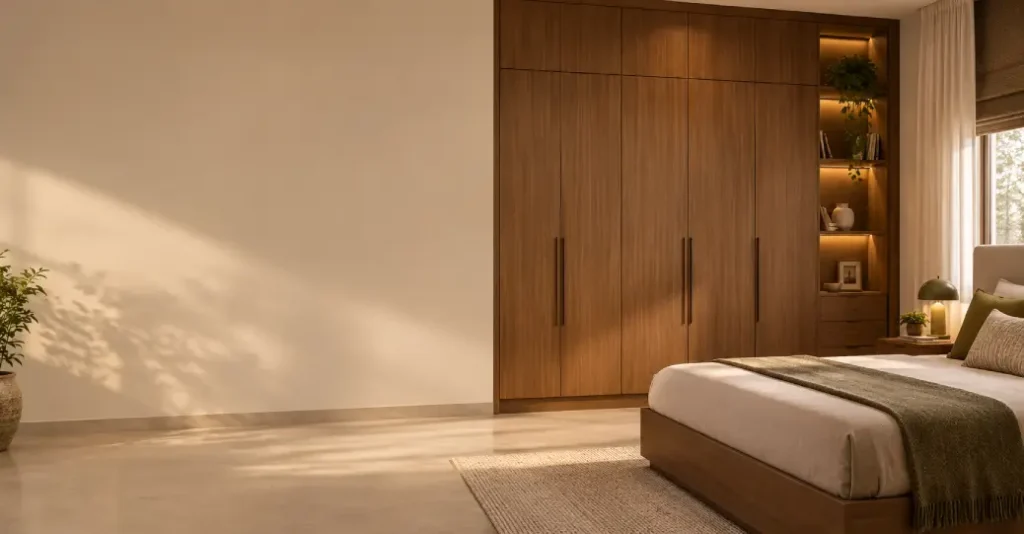
Why This Even Matters
A wardrobe is not just furniture standing in the corner of your room. It has to deal with Chennai-level heat, monsoon moisture, sometimes termites, and years of people banging the doors shut every morning while getting late for office.
The material decides a lot of things. How long before the shutters warp. Whether damp near the bathroom wall becomes an issue. How much money you spend fixing it two years down the line. Even how the room feels overall.
Pick the wrong wardrobe material, doors swell, laminate peels off, sometimes there’s a smell too. Pick the right one, it just works. Years go by and you don’t even think about it.
We’ve seen five-year-old wardrobes where the shutters won’t close anymore. Almost every time, the owner picked the design and colour first, and the material was an afterthought. That’s the wrong order. Material first, then the pretty stuff.
Plywood
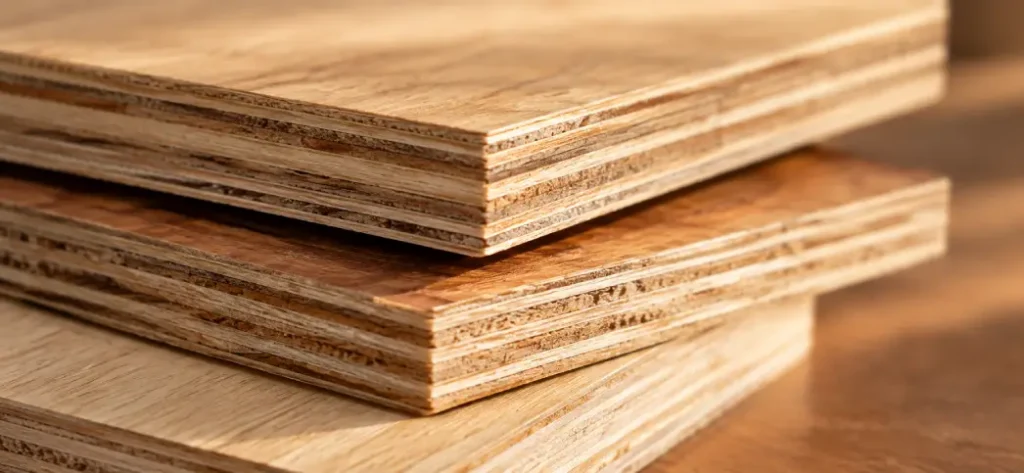
This is what most designers in Coimbatore will tell you to go with. It’s made by gluing thin sheets of wood on top of each other, each layer facing a different direction. That’s what makes it strong.
Good things about plywood as a wardrobe material:
- Handles moisture much better than cheaper boards
- Screws and hinges stay tight, so no sagging shutters after a year
- Comes in grades, MR, BWR, BWP, so you can pick based on how much water protection you need
- Laminate, veneer, paint, all stick well on it
Only issue, it costs more than MDF or particle board. But if you want a wardrobe that survives 15-20 years without you calling the carpenter back, this is usually the one.
For bathrooms or if you live near the coast, go BWP grade. Boiling waterproof, basically the strongest option. For a normal bedroom, MR grade plywood is fine, and cheaper too. A lot of people think all plywood is same-same. It’s not. The grade written on the sheet matters a lot more than people realise.
MDF
MDF means Medium Density Fibreboard. Wood fibres pressed together with heat. Smoother than plywood, that’s why people like it for sleek, no-grain shutter designs.
Where it does well:
- Paint finish comes out very smooth on MDF
- Cheaper than plywood usually
- Good if you want curved or fancy shutter cuts
Where it fails, MDF soaks up water faster than plywood. Gets wet again and again, it starts swelling. Screws also don’t hold as well, so heavy hinges can come loose over time. Near a bathroom, or in a coastal home, we wouldn’t suggest it.
But if your budget is small and your area is dry, MDF wardrobe material can still last you a good ten years. Just don’t bang the doors fifty times a day, that’s asking too much from it.
Particle Board
Wood chips and sawdust, pressed together with resin. Cheapest option out there, which is why you see it a lot in rented flats and low-budget projects.
Not going to sugarcoat this one:
- Weakest wardrobe material when moisture gets involved
- Screws loosen quick with regular use
- Light in weight, easy to install, but that same lightness means it wears out faster
We’re not saying don’t use it ever. For a rental, or a guest room where budget is really tight, it can work for a while. Just don’t expect it to last 15 years like plywood does. It was never built for that.
WPC
Wood Plastic Composite. Newer option, becoming more common in bathrooms, utility rooms, kids’ rooms, basically anywhere spills happen a lot. It’s wood fibre mixed with plastic, so it’s actually waterproof. Not water-resistant, waterproof.
Why it’s good for wet areas:
- Won’t swell or rot, no matter how wet it gets
- Termites can’t eat it, nothing for them to chew on
- Doesn’t need edge banding like plywood or MDF does
Downside, it costs more, sometimes even more than plywood. And since it’s still new here, not every carpenter knows how to work with it properly. The final quality often comes down to the professional you choose. So pick someone with actual experience if you’re going this route.
Solid Wood
Teak, sheesham, this kind of thing. This used to be the normal choice a generation back. You still see these old wardrobes in older houses, heavy, solid, looks like it’ll outlast the house itself.
Problem is cost. Solid wood is expensive, needs regular polishing, and can still warp if humidity swings a lot. Most people have moved to plywood or MDF now, similar strength, way cheaper, and less maintenance. Solid wood still has a place, maybe for one statement piece, or a heritage-style home. But for a full wardrobe on a regular budget, it’s rarely the practical pick anymore.
Laminate and Veneer Are Not the Material
A lot of people get stuck on this point, so let’s make it clearer. Laminate and veneer are not wardrobe materials by themselves. They’re finishes. A layer that sits on top of plywood, MDF, or particle board.
Laminate is a synthetic sheet. Comes in loads of colours and patterns, holds up well against scratches.
Veneer is made from a very thin layer of natural wood that is bonded to a surface. Looks more natural, but needs more care and costs more.
So when someone says “laminate or plywood for my wardrobe,” they’re mixing up two different things. Plywood is the base wardrobe material. Laminate is what sits on top of it.
Sliding Doors or Hinged, Does It Matter?
Most people never think about this. The base material stays same either way, but sliding wardrobes put more pressure on the track and rollers, so the panel needs to be lighter. MDF or a lighter plywood works fine there. Hinged wardrobes carry the weight differently, through the hinges on the side, so a stronger board like BWP plywood holds up better over years of daily use.
Small thing. Carpenters usually don’t mention it. But it does affect how long the wardrobe stays sturdy.
Don't Ignore the Hardware Inside
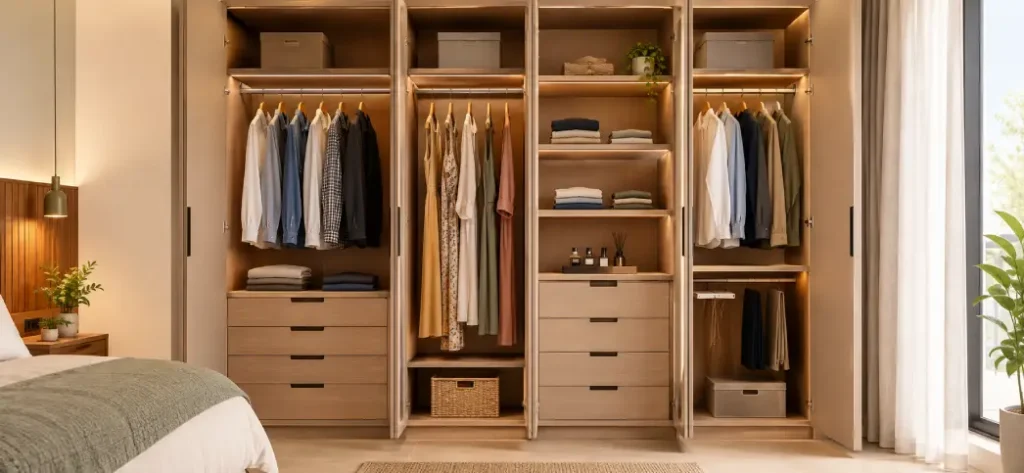
People spend weeks picking the outer wardrobe material, then just let the carpenter use whatever hinges and channels he has lying around. That’s a mistake. Strongest board in the world won’t help if the hardware inside fails first.
Things worth checking, no matter which material you go with:
- Soft-close hinges, especially with lighter material like MDF
- Drawer channels rated properly for the actual weight
- Shelving in plywood or WPC for damp areas, not painted MDF
- A slightly thicker panel behind any mirror, so that side doesn’t feel heavy
None of this replaces choosing a good base material to start with. It just makes sure the rest of it keeps up.
How to Actually Pick One
This is roughly how we walk clients through it.
Start with the room. Bathrooms and kids’ rooms need something moisture-proof, so BWP plywood or WPC. Normal bedrooms are fine with MR plywood, or even MDF.
Be honest about your budget. Particle board and MDF cost less right now. Plywood and WPC cost more now, but you save on repairs later.
Think about your climate. Coimbatore is not as humid as coastal cities, but monsoon still brings dampness indoors. If the wardrobe is against an outer wall, go with something stronger. Plywood, ideally.
Think about how it’ll actually be used. Wardrobe getting opened twenty times a day by kids, it needs to hold hardware well. That rules out particle board pretty much immediately.
Don’t skip the finish. Good material with a bad finish still looks cheap. Match it with laminate or veneer that suits your taste and your budget.
Mistakes People Keep Making
Going by price alone, then paying way more later in repairs.
Not thinking about how damp the room actually gets.
Never checking the plywood grade. MR and BWP behave very differently once humidity kicks in.
Falling in love with a laminate colour and forgetting to ask what’s underneath it.
Not asking to see or touch a sample before saying yes to anything.
What Wardrobe Material We Actually Use at Terazzo
For most of our projects in Coimbatore, MR-grade plywood is our default for regular wardrobes, and BWP grade wherever moisture is a real concern. WPC comes in when someone specifically wants a fully waterproof wardrobe, mostly for bathrooms or utility spaces. And when MDF or particle board genuinely makes sense for someone’s budget, we say so honestly.
We’re not trying to push the most expensive material on you just because it sounds fancy. We’d rather find what actually fits your room, your budget, and how your family lives day to day. That conversation happens before the design work starts. Not after you’ve already fallen for a laminate colour.
One thing we’ve noticed, after enough projects, people almost never regret spending a little more on the base material. They regret cutting corners there to save money on something more visible, like a handle or a finish. Five years later, nobody remembers the handle. They remember whether the door still shuts properly or not.
Let's Build One That Actually Lasts
You shouldn’t have to figure all this out alone, standing in some hardware shop staring at plywood samples with zero context. Just talk to us. We’ll walk you through what actually suits your home, your climate, your budget, and we’ll build it properly, the first time.
Reach out to Terazzo and let’s sort your wardrobe out, done right.
Frequently Asked Questions About Wardrobe Material
1. What lasts longest in Coimbatore's weather?
BWP plywood, mostly. It deals with the mix of dry heat and monsoon dampness better than most other options, especially near outer walls.
2. Is MDF a bad option for a bedroom?
Not really. As long as the room stays dry and it’s not being opened constantly, it’s a decent, affordable choice.
3. Can I use different materials in one wardrobe?
Yes, people do this all the time. Plywood body, MDF or laminate shutters. Gets you strength where needed and a clean look where it shows.
4. How do I check the plywood grade myself?
Ask to see the grade stamp on the actual sheet. Don’t just take someone’s word for it. A good vendor will happily show you.
5. Does the material change how the wardrobe smells when it's new?
Sometimes yes. Cheaper boards with more resin can smell sharp for the first couple weeks. Usually fades on its own. If it’s still there after a month, ask what glue or adhesive was used.