
How to Choose Wooden Flooring for Your Home
Summary
Choosing wooden flooring for your home involves considering durability, room usage, moisture levels, and style preferences. Solid hardwood offers a natural, long-lasting option that can be sanded and refinished multiple times, making it suitable for low-moisture areas such as bedrooms and living rooms. Engineered wood is more resistant to humidity and temperature changes, while laminate is a budget-friendly choice for high-traffic areas. Vinyl wood planks provide waterproof performance, making them ideal for kitchens and bathrooms.
The wood species should also match the level of traffic and your desired appearance. Oak is durable, scratch-resistant, and easy to stain, making it suitable for busy spaces. Walnut creates a luxurious, rich appearance but can scratch more easily with heavy use. Teak is naturally resistant to moisture and insects, making it a practical choice for humid environments and areas that experience frequent use.
Finally, consider the plank size, texture, and finish to achieve the right combination of appearance and practicality. Narrow planks create a traditional look, while wider planks provide a more modern appearance. Brushed textures can help hide everyday wear in busy rooms, whereas smooth finishes work well in quieter spaces. Protective finishes such as polyurethane can also provide better resistance against dirt and water, helping maintain the flooring’s appearance and durability.
Share via:
How to Choose Wooden Flooring for Your Home
Picking wooden flooring feels simple until you actually start looking. Walk into any showroom and you’ll see oak, teak, engineered planks, laminate that looks like wood but isn’t, and a sales team ready to tell you every single option is the best one. We’ve sat with enough homeowners at Terazzo to know how confusing this gets, so this is the honest version of what actually matters when you are picking flooring for your home, and what you can safely ignore.
Why It Still Wins Over Other Flooring
Tiles are cooler underfoot. Vitrified flooring is tougher against scratches. Marble looks grand in photographs. So why do people keep circling back to wood?
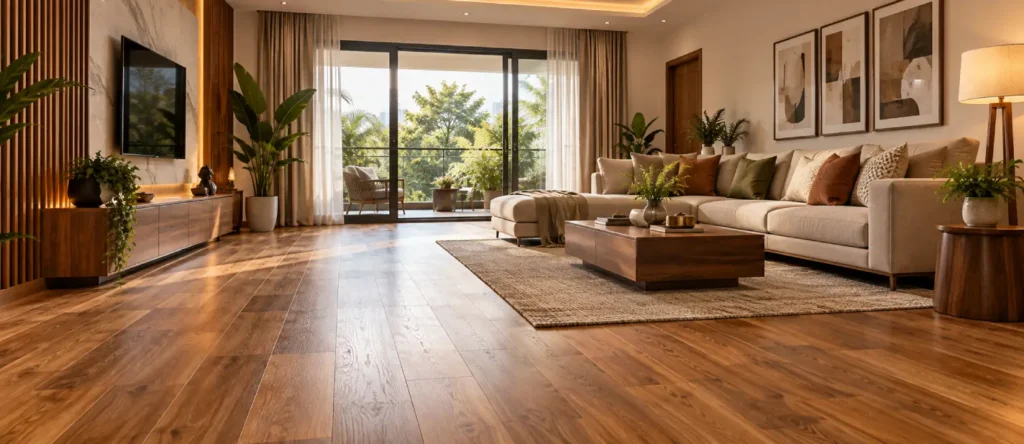
Because it does something the others do not. It warms up a room instead of just filling it. A tiled living room can look sharp in a catalogue and still feel a bit cold to sit in every evening. Wood does not have that problem. It ages with the house instead of just sitting on top of it, and that’s a quality most other materials can’t fake.
There is a practical side too. Good wooden flooring handles Indian humidity better than most people assume, as long as you pick the right type for your climate. It is also easier on the joints if you have older family members at home this is a real consideration in a lot of Indian households where three generations share one roof. It hides everyday wear far better than glossy tiles do. A small scuff or a dragged chair mark blends into the grain instead of standing out like it does on a shiny tile.
And then there’s resale value. Buyers notice good flooring even when they can’t quite say why a home feels more put together. None of this means wood belongs in every single room of the house. It’s just right for more rooms than people usually think.
The First Real Decision: Solid or Engineered
This is where most homeowners get stuck when comparing wooden flooring options, so let’s sort it out early.
Solid wood flooring is exactly what it sounds like: a plank cut from a single piece of timber, usually teak, oak, or sal. It’s the flooring your grandparents probably had at home, and it can genuinely last for decades if it’s cared for properly.
Engineered wooden flooring is a plywood or HDF base with a thin layer of real wood bonded on top. It looks nearly identical once installed, costs less, and handles temperature and humidity changes better because the base layers run in different directions and resist warping.
This is how we usually explain this trade off to clients who walk into our studio:
- Go solid if you’re staying in the home long term and want something you can sand and refinish several times over the years
- Go with engineered wooden flooring if you’re in an apartment, dealing with a concrete slab, or want a strong finish without the solid wood price tag
- Go engineered if your city sees serious humidity swings through the year and it is more dimensionally stable and less likely to develop gaps
We have installed both types across homes in Coimbatore, and honestly, engineered flooring wins for most urban households simply because it adjusts to local conditions with less fuss and fewer callbacks after monsoon season.
Matching the Wood to the Room
Not every room deserves the same wooden flooring. Each space in your home has its own demands, so it helps to think room by room instead of picking one type for the whole house.
Living rooms and bedrooms are where this flooring does its best work. Go for a mid to dark tone if the room gets plenty of natural light through the day, and a lighter shade if the room tends to stay dim. Dark planks in a dim room just make the whole space feel smaller than it is.
Kids’ rooms need a harder species or a scratch resistant engineered option. Toys, chairs being dragged around, and general chaos are non negotiable in a child’s room, so whatever you install needs to keep up without showing every mark within a month.
Kitchens need a proper moisture-resistant finish, or you should skip wood here altogether. Spills happen daily in a working kitchen, and untreated planks swell fast when water sits on them even briefly.
Bathrooms are where we’ll be straight with you don’t skip it entirely in wet areas. Even the best engineered wooden flooring options struggle against standing water over time, no matter what the salesperson promises you. If you love the look, wood-finish tiles mimic it convincingly and handle water without complaint.
Balconies and open outdoor spaces need outdoor-rated wood or composite decking, not the indoor variety. Regular planks will warp under direct sun and rain within a single season, so don’t let anyone talk you into it for an open terrace.
What Actually Drives the Price
People often ask us why one quote comes in double another for what looks like “the same wood.” A few honest factors explain this gap.
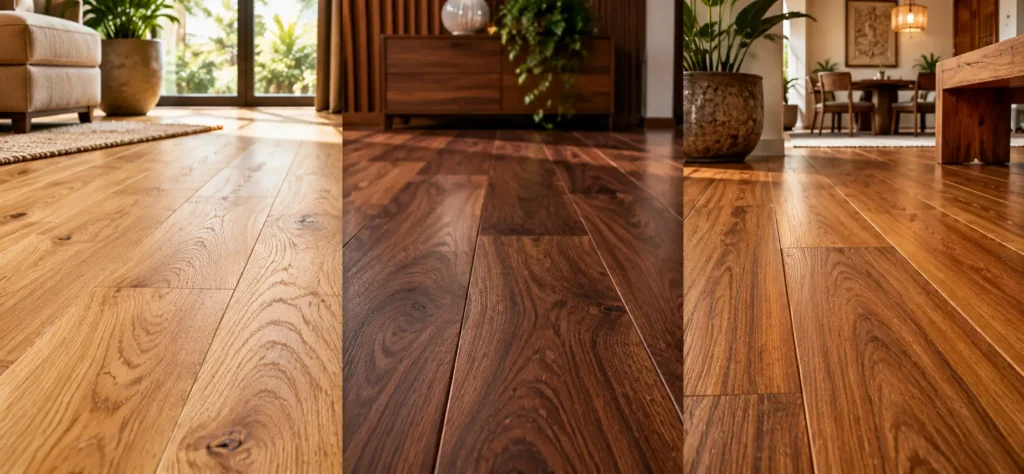
Species matters most. Teak costs more than oak in India because it’s locally prized, dense, and genuinely durable in our climate. Sal and mango wood sit lower on the price scale and still hold up reasonably well for budget-conscious homes.
Plank thickness plays a role too. A thicker top wear layer on engineered planks costs more upfront but also survives through more sanding and refinishing cycles down the line, which adds years to its life.
Finish type changes the price as well. Matte, oiled, and UV cured finishes all carry different price points and ask for different upkeep and an oiled finish, for instance, needs more frequent attention than a UV cured one.
Installation method affects the final bill. Click lock systems install faster and cheaper than nail down or glue down methods, which need more skilled labour and more time on site.
Brand and sourcing add a premium too. Imported options carry higher price tags, partly for quality control and partly for the label itself, though local sourcing has come a long way in recent years.
If your budget is tight, don’t cut corners on installation labour to save money. A mediocre installer can ruin even a premium product by things like gaps, uneven subfloor prep, and rough transitions between rooms that show up within months, and fixing them later costs more than doing it right the first time.
Questions to Ask Before You Sign Off
We always tell clients to ask a few things before finalising any order for their home.
Inquire into the moisture content of wood and if it has been properly kiln dried before it arrived at the job site. Inquire if the warranty is on the finish or the structure or both sometimes they’re different and have different terms. Seek honest answers as to the maintenance requirements and how frequently they are actually required, not what the brochure states. Request to examine a home in which it is used instead of just a showroom sample in studio lighting. Also ask what will happen years later if a single plank is damaged, can it be replaced separately or must the entire section be redone?
When a supplier provides these answers clearly, and doesn’t dodge or give circular answers to the question, they are a trustworthy supplier to trust. If they avoid talking about moisture content or long term maintenance, it’s a red flag to move on.
Caring for It Day to Day
Wooden flooring is not a no maintenance option but it does require some degree of uniformity from the house’s inhabitants.
Sweep or vacuum frequently over time, grit under bare feet will wear down the finish, more rapidly than anything else. Clean up spills as they happen rather than allowing them to sit on grain to absorb. Do not use a ‘wet mop’ but use a slightly damp one as well, and also refrain from using strong chemical cleaners—use a wood specific product instead that will not strip the finish. Use felt pads under furniture legs to prevent a permanent mark being created when furniture is dragged.
Mistakes Homeowners Keep Making
A few patterns come up again and again with clients who have had a rough experience elsewhere.
Choosing purely from a showroom sample is a common one. Lighting and room size change how a wood tone reads once it’s actually laid down, so always ask to see a larger sample inside your own home before committing. Ignoring the subfloor is another mistake, even great wooden flooring installed over an uneven or damp subfloor will fail early, no matter how good the material itself is. Picking a finish that doesn’t match how the family actually lives is a third mistake. A high gloss finish looks stunning in photographs and shows every scratch within weeks if you have pets or young kids running around. Skipping the acclimatisation period causes trouble too even wood needs a few days to adjust to a room’s humidity before it gets installed, and rushing this step leads to gaps or buckling later. And going purely on price ends up costing more in the long run, once you factor in early repairs and replacements from cutting corners upfront.
Where the Wood Comes From
This part of the story is not discussed enough and it should be! If you are concerned about your materials’ source, a significant portion of the wooden floors sold in India today are sourced from plantations instead of old growth forests. The production of commercial timber for furniture and flooring has been in practice for several decades in states like Kerala and Maharashtra and is done on teak plantations rather than natural forests.
Before making a decision, enquire about the timber used in wooden floors from your supplier. A supplier with a wood sourcing chain back to a specific plantation or certified source is more reliable in all aspects, including sustainability. It typically translates to improved quality control throughout the cutting process, in the kiln-drying process, and even at home, where the final product is finished.
Bamboo is a grass, not wood, and is in the discussion as well. It grows up faster than any other tree species and is reasonably tolerant of Indian humidity so be sure to check it out if sustainability is among your criteria, as well as durability.
How Long Installation Actually Takes
Homeowners are often surprised by the timeline once they’ve picked their flooring. A single average sized room with engineered planks and a click lock system usually takes a day, sometimes less if the subfloor is already level and dry. Solid wood installed with a nail down or glue down method takes longer, often two to three days per room, because it needs more prep work and more time to settle before the finishing coat goes on.
If you’re working on your entire house, take a couple more days, and allow the wood to “acclimate” to your home’s humidity before installation even starts. With this, one of the more typical family regrets heard is rushing this step, leaving the gaps visible 6 months later when the family was prepared to buy the work done in a weekend. Patience during the installation period will be rewarded with good flooring, more than if it were a bit longer.
Conclusion
Choosing wooden flooring is not about finding the single “correct” wood type for every household. It is about matching the material to your rooms, your budget, and how your family actually lives day to day. A young family with kids needs different choices than a couple in a quiet apartment, and that is completely fine because there’s no universal right answer here, just the right answer for your home.
At Terazzo, we walk through this decision with every client before a single plank gets ordered, room by room and budget by budget. If you’re planning your interiors and want wooden flooring that actually suits how you live, reach out to us. We’ll help you get it right the first time.
Frequently Asked Questions About Modular Kitchen Buying Guide
1. What is the Rule of 3 for flooring?
Basically, stick to three flooring materials or wood tones max in one connected space, otherwise it starts looking cluttered.
2. How much does 1000 sq ft of wood flooring cost?
You’re looking at somewhere between ₹1.5 lakh and ₹6 lakh or more, depending on whether you go laminate, engineered, or solid wood, plus what installation adds on top.
3. What type of wood is best for flooring?
Teak is usually the go to for Indian homes, it just holds up better against our humidity and pests than most other options.
4. What are the three types of wood flooring?
Solid wood, engineered wood, and laminate that’s made to look like wood.
5. What is the most popular type of wood flooring?
Engineered wood, mostly because it’s cheaper and handles humidity swings better than solid wood.