
Sliding Wardrobe or Hinged Wardrobe? This is How to Actually Decide
Summary
Choosing between a sliding wardrobe and a hinged wardrobe mainly depends on your bedroom space, budget, lifestyle, and design preferences. Hinged wardrobes use doors that swing outward and require around 2–2.5 feet of clearance, while sliding wardrobes move sideways along tracks and do not need additional floor space. This makes sliding wardrobes particularly suitable for compact bedrooms, where furniture placement and walking space are limited.
In terms of cost, accessibility, appearance, and maintenance, both options have their own advantages. Hinged wardrobes are generally more affordable, provide complete visibility of the wardrobe interior, and are easier to repair. Sliding wardrobes usually cost more because of their tracks and rollers, but they offer a sleek, modern appearance and greater flexibility for furniture placement. However, their tracks need regular cleaning and maintenance, while hinged doors may experience loose hinges or swelling in humid conditions.
Ultimately, there is no universally better choice—the right wardrobe depends on how you use your bedroom. Sliding wardrobes are ideal for smaller rooms, modern interiors, and long-term homes where saving space is important, while hinged wardrobes are better for tighter budgets, full wardrobe visibility, and homes where the furniture may need to be moved. Most importantly, the quality of construction and hardware matters more than the door mechanism itself. Consider your room dimensions, budget, users, future furniture needs, and build quality before making the final decision.
Share via:
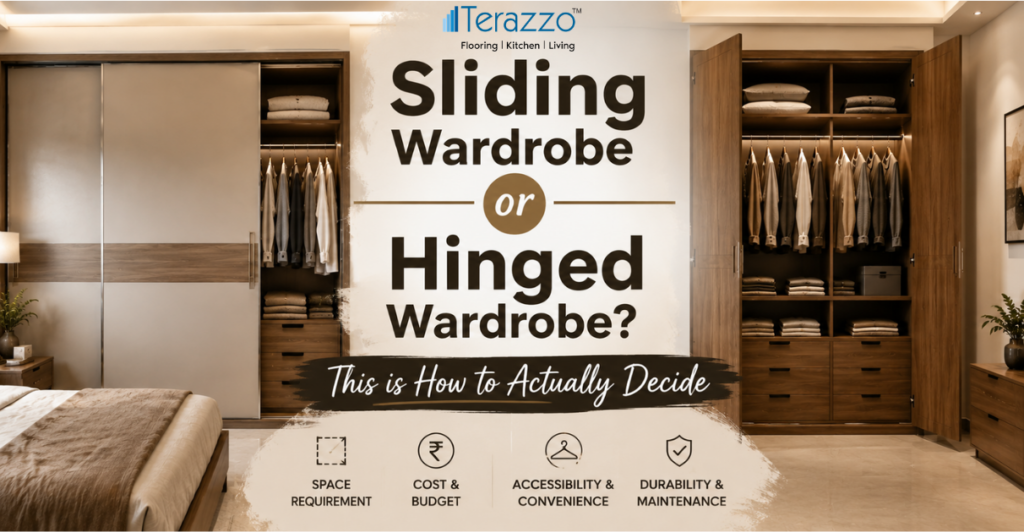
Sliding Wardrobe or Hinged Wardrobe? This is How to Actually Decide
We get asked this a lot, usually by someone standing in a half finished bedroom with a tape measure, trying to figure out what will actually fit. It’s a bigger decision than it looks like on paper, because you’re not just picking a door style, you’re picking how your mornings are going to feel for the next ten-plus years. So let’s go through it properly, without the sales pitch.
The Basic Difference
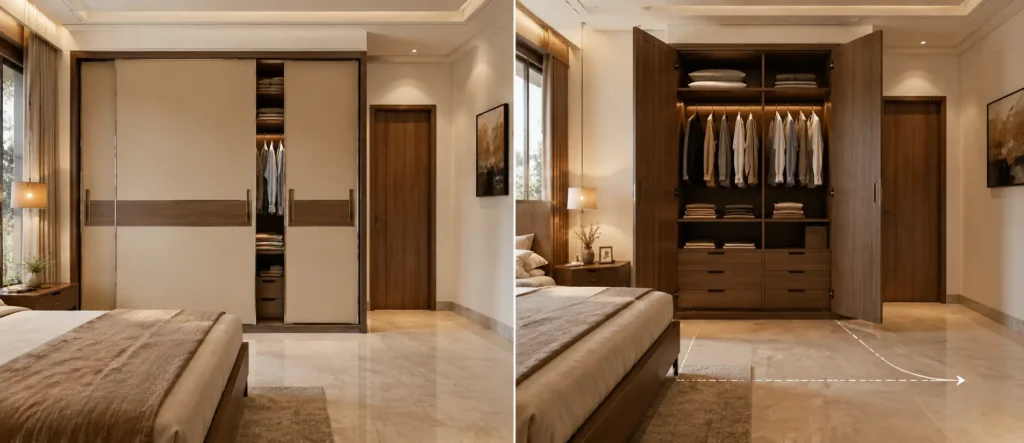
A hinged wardrobe has doors that swing open, like a regular room door. You need floor space in front of it for that swing.
A sliding wardrobe has doors that glide sideways on a track. Nothing swings into the room. You slide one panel across while the other stays put.
That one mechanical difference is where every other trade-off comes from: cost, how the doors are built, how much space you need, even how long the thing lasts. Once that clicks, the rest of this decision gets a lot easier.
How They're Put Together
Hinged wardrobes are fixed cabinets. The frame doesn’t move, and the doors bolt onto the sides with two or three metal hinges each, depending on the door’s size and weight. It’s the same idea as any cupboard you’ve owned since childhood, nothing fancy, and that’s kind of the point.
Sliding wardrobes hang from a track, usually at the top, sometimes at the bottom too, and roll along it on small wheels. No hinges, no pivot point, no swing arc to plan around.
I’ll admit sliding systems look more impressive when you see them installed, but the hinged mechanism has been doing its job quietly for decades because it barely has anything to break.
Space: Where Most People Choose a Sliding Wardrobe
This is usually the deciding factor, and honestly, it should be.
A standard hinged door needs roughly 2 to 2.5 feet of clear floor space to open all the way. In a small bedroom, that clearance can dictate where your bed sits, where a side table goes, even how you walk through the room every morning without stubbing a toe.
A sliding wardrobe doesn’t ask for any of that. The doors move flat against the wall, so you can push a bed or a dresser right up to the wardrobe front and still open it without any trouble.
I’ve seen sliding doors solve rooms where a hinged door would’ve hit the bed frame every single time you opened it. One client had a queen bed pushed almost against the wardrobe wall. A hinged door simply wasn’t happening there, and once we switched the plan to sliding, the whole layout suddenly worked.
This matters more in a lot of Indian homes, where bedrooms tend to run smaller than what you’d find in a typical Western floor plan. A rough guide:
- Small room, under 120 sq ft: sliding is the easier call
- Medium room with furniture packed in tight: sliding still usually wins
- Large, open bedroom: either works, it’s mostly about taste at that point
If you’re not sure which bucket your room falls into, measure the clear floor space in front of where the wardrobe will go, not just the wall length. That number tells you more than the room’s total square footage ever will.
Cost: Hinged Is Usually Cheaper Than a Sliding Wardrobe
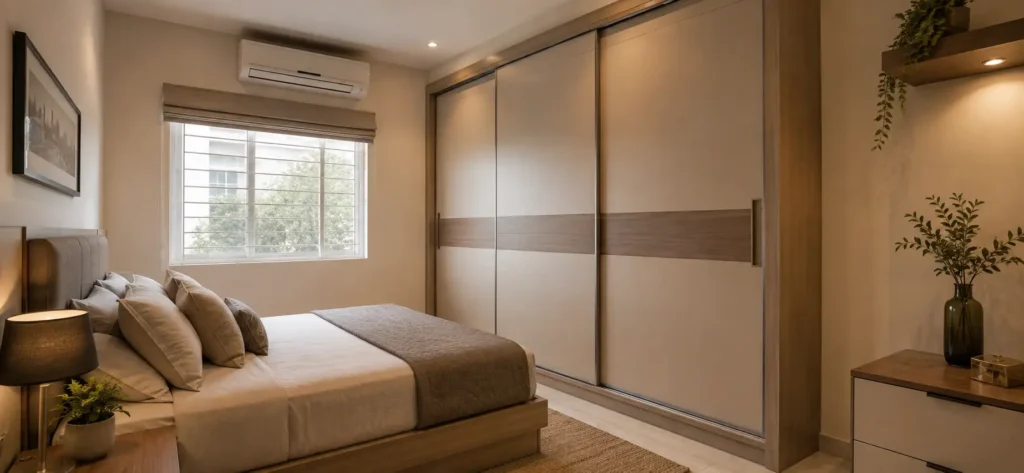
A sliding wardrobe costs more than a hinged one for the same size and finish, mainly because of the track hardware and rollers. There’s more engineering going into making a heavy sliding wardrobe door glide smoothly for years without jamming.
Hinged wardrobes use simpler parts. Fewer things that can go wrong, and cheaper to fix years down the line if something does. A loose hinge is a five-minute job for anyone with a screwdriver.
Rough numbers, based on what we’ve quoted clients: sliding wardrobes typically run 15 to 30% more than a comparable hinged one. That gap shrinks if both use a basic laminate finish, and grows if you add mirrored or glass panels to the sliding doors, since those panels aren’t cheap to source or fit. Get quotes for your exact size and finish before assuming one is definitely cheaper. The gap isn’t always as big as people expect, and sometimes a well-built hinged wardrobe with premium internals costs more than a basic sliding one.
Getting to Your Clothes
A hinged wardrobe opens and reveals all shelves, hangers, drawers at once. No more trying to find things out.
When you have a sliding closet, you will always be able to see a part of the cabinet, and you’ll never have to see the whole thing. A sliding wardrobe will be forcing you to shift back and forth more than you would like to, particularly in the morning rush, when you are already running late.
It is not a big deal, but the inside design should be further thought of. The trick is to store your everyday clothing (work shirts, daily-wear kurtas, etc.) on the side you habitually open, and load up the rare occasion when you need to grab some blankets or festive clothes on the far side you don’t need immediately. This is a little planning detail, but it can save a lot of daily aggravation once the wardrobe is in place and you’re living in it.
Looks
This is one you can’t avoid. A sliding wardrobe provides a more streamlined and tidy appearance. A small room can look larger and brighter with no handles sticking out and no visible hinges on a sliding wardrobe, plus mirrored or laminate panels on the container.
While hinged doors may look just as nice with panel detailing, or a textured finish, they appear more conventional. There are others who specifically desire that sturdier and classic appearance and really, that is only fair, it is not a compromise, it is just a taste.
A few finish options you should be aware of, as the finish can make as much difference in the ambiance of the room as the door mechanism does:
- Mirrored sliding doors: light up a small room and use as a full-length mirror, but the mirrors pick up smudges quicker than you realize
- Warm, classic, mates with wood furniture, matte laminate hinged panels don’t finger print.
- Glass-inlay sliding doors: modern-looking, but you’ll be wiping fingerprints off them more often than you’d like
- Wood-grain hinged doors: suits a more traditional bedroom, ages well if the laminate is decent quality
Upkeep
Hinges can become loose over time, but a technician does not need to tighten a screw, it only takes two minutes.
There is a little more work to be done on the tracks for a sliding wardrobe. Doors will slide easily for years if kept clean and dust-free. Skip that upkeep, and a sliding wardrobe will begin to get sticky or noisy, typically when you’re in a rush to get something. It’s not a dealbreaker, just something to keep in mind if you’re not naturally the type to do occasional maintenance.
A short checklist for sliding wardrobes:
- Wipe the tracks every few months
- Check the rollers aren’t collecting lint or hair
- Let the doors glide shut instead of slamming them
- If you live somewhere dusty, get the track alignment checked once a year
Hinged doors do not require as much effort on your part every day, but do have their own quirks. Wooden frames can swell enough in humid climates for the door to stick at the edges of the frame, and the hinges can loosen up over time, causing the door to sag a little. Both problems are not expensive to correct, but it is important to be aware of before making a decision.
A Few Quick Questions to Ask Yourself
- Is your bedroom compact? Go sliding.
- Want the cheaper option that still looks decent? Go hinged.
- Like seeing your whole wardrobe in one glance without sliding a panel? Go hinged.
- Want a sleek, modern bedroom look? Go sliding.
- Rearrange furniture often? Sliding gives you more freedom since there’s no swing radius to plan around every time you move things.
There’s no single “better” answer here, just a better fit for your room, your budget, and how you actually use your closet every single day.
If You're Renting, or Might Move Soon
This one is often forgotten and perhaps it should be. If you’re living in a rented apartment or plan to redecorate or relocate in a couple of years, consider the ease with which the wardrobe can be dismantled or moved.
Generally, freestanding wardrobes with doors that swing open are easier to break down and move. A lot more frequently, a sliding wardrobe is built as a standstill structure within the wall, which makes relocating a sliding wardrobe considerably more difficult, if it is even worth the effort.
If you own your home long-term, this probably won’t matter much to you. If you’re renting or expect to move in the next few years, it’s a real factor worth weighing before you sign off on either option.
What We Notice, Working With Clients
We’ve noticed a pattern over the years. Younger buyers furnishing their first apartment usually go sliding, smaller space, more modern taste, simple as that. Families in bigger homes, especially with kids who need quick, full-view access to their clothes in the morning rush, tend to lean hinged.
Neither group is wrong. It genuinely comes down to how the household moves through the room every morning, not some universal rule about which one is “better.”
This i’s something interesting, though: once someone’s lived with a sliding wardrobe for a while, they rarely go back to a hinged one in their next home. Mostly because they stop thinking about door clearance altogether once they have a sliding wardrobe, it just becomes the normal way things work. On the flip side, people who’ve had hinged wardrobes their whole lives sometimes take a week or two to get used to sliding doors, especially reaching around a panel for something on the far side. Both are just habits, and both wear off faster than people expect.
Before You Lock In Your Decision
A few things people forget to check, and end up regretting later:
- Minimum ceiling height: there are some sliding wardrobe systems that require minimum ceiling height for the top track to be properly installed.
- Wall alignment: A wardrobe with a sliding mechanism should be aligned on a flat and even wall, otherwise it may stick or wobble.
- Future furniture: a study table or dresser you add later might be limited by where a hinged door swings open
- Who’s actually using it: kids and older family members often find sliding doors easier to manage since there’s no heavy door to pull and hold open
None of these are dealbreakers on their own, but missing one can turn into a small daily frustration you didn’t see coming.
Our Take
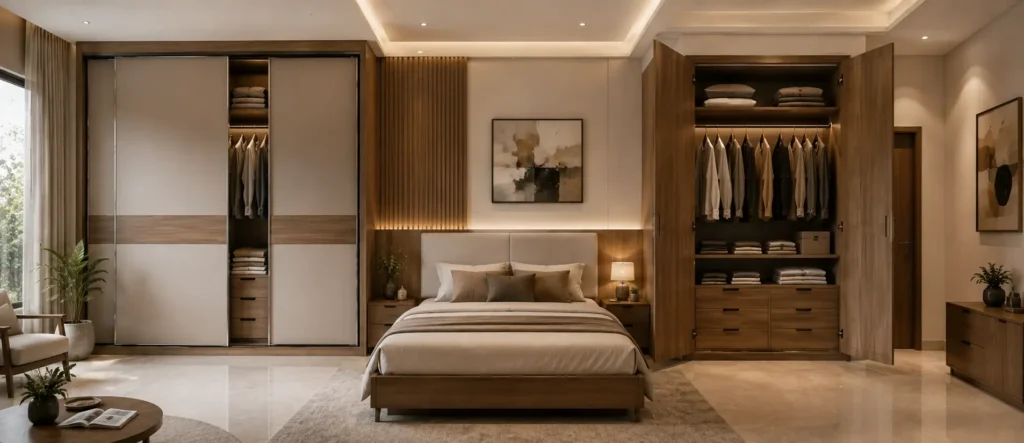
In one word: sliding wardrobes are modern and save space, hinged wardrobes are simple and are more affordable. They are both durable and enduring options if they’re constructed properly, and it doesn’t matter which one you choose as long as it’s built well.
A low cost sliding wardrobe with weak tracks will make you madder than a hinged wardrobe will make you.
A cheap sliding wardrobe with flimsy tracks will frustrate you faster than a well-made hinged one ever would. And a poorly fitted hinged door with weak hardware will start sagging within a year. The mechanism matters less than the craftsmanship behind it. We say this even though it means talking some clients out of the pricier option.
So if you’ve been going back and forth on this for weeks now, stop overthinking the mechanism itself. Start thinking about the room it’s going into, the budget you’ve actually set, and who’s checking the quality of the build before it lands in your bedroom. Those three things decide whether you’re happy with your wardrobe in year one, or still fighting with it in year five.
Quick Recap Before You Decide
- Tight on space: sliding wardrobe
- Tight on budget: hinged wardrobe
- Want full-view access: hinged wardrobe
- Want a modern, streamlined bedroom: sliding wardrobe
- Renting or planning to move soon: hinged wardrobe, generally easier to shift
- Long-term home, don’t mind the higher upfront cost: sliding wardrobe
Print this list out, walk into your bedroom, and see which side wins more checkmarks. That’s usually all it takes to settle this for your specific space.
Conclusion
We’ve gone through this from every angle that actually matters: space, cost, access, looks, and upkeep. At this point, you probably already have a gut feeling about which one suits your home.
At Terazzo India, we design and build both types, sized to your room’s actual dimensions, not some one-size-fits-all template. Our team visits, measures, and shows you real options before you commit to anything.
Reach out to us today, and let’s figure out which wardrobe actually works for your space, not just on paper, but in real life.
Frequently Asked Questions About Home Interior Budget Planning
1. Which is better, a sliding wardrobe or hinged wardrobe?
A sliding wardrobe is ideal for compact rooms, while a hinged wardrobe suits larger spaces and tighter budgets.
2. Is a sliding wardrobe better for small bedrooms?
Yes. A sliding wardrobe saves floor space because its doors move sideways instead of swinging outward.
3. Is a hinged wardrobe cheaper than a sliding wardrobe?
Generally, yes. Hinged wardrobes use simpler hardware and are usually more affordable than comparable sliding wardrobes.
4. Which wardrobe is easier to maintain?
Hinged wardrobes are generally easier to maintain, while sliding wardrobes require regular track and roller cleaning.
5. How do I choose between sliding and hinged wardrobes?
Consider your bedroom space, budget, storage access, design preference, and whether you plan to move or rearrange furniture.